Archive for the 'Italian' Category


Spaghetti al Pomodoro (Spaghetti with Tomatoes)

CRW_9746

Sometimes the simplest things are the best. And I think that spaghetti with a simple tomato sauce is one of them. Just the taste of pure, ripe tomatoes. Not overcooked and not overly complicated.

Recently, there was a book published (which I haven’t read) regarding the choice of last meals for chefs (apparently that discussion is popular among chefs). Apparently, the most common selections are simple, classic foods (with Mario Batali a notable exception). I would like to think that spaghetti al pomodoro would be a similar meal. Would it be my choice for a least meal? I don’t know. I don’t particularly relish the idea of devising a last meal.

In any case, I do like simple tomato sauces on pasta. There’s something both comforting and tasty about it. I’ve tried a number of different techniques and, while I still like a complicated ragú based on my grandmother’s, I think I’ve found a good option for a simple and fresh version.

This recipe really depends on the freshness of the tomatoes. I really don’t think it would nearly as well with canned tomatoes (even San Marzano). When we went to the Santa Monica Farmer’s market, I found several smallish tomatoes that were advertised as being especially for sauce. Given that I only ever really use tomatoes for sauces, I figured they’d be a good choice.

CRW_9743

This is fundamentally a simple recipe. The hardest part is making the pasta but that could be easily replaced by factory pasta.

My technique for pasta making comes mainly from experimentation. I have found that a ratio of 1 cup of King Arthur all purpose flour to 1 extra-large egg (the size of the egg is important). This is not the ratio recommended in any cookbook I’ve ever found (most recommend using large eggs but extra-large eggs are cheapest atTrader Joe’s). I don’t know how important the brand of flour is. I always make my pasta by the well method as it doesn’t seem worth dirtying my mixer bowl.

I wouldn’t recommend rolling the pasta by hand. I tried once (before I had a pasta maker) and it was a disaster. Without a pasta maker, use factory made pasta.

CRW_9737

Spaghetti al Pomodoro (Spaghetti with Tomatoes)
Adapted from Essentials of Classic Italian Cooking

1 lbs. tomatoes
1/4 large onion, skin removed
2 1/2 tbsp butter
Fresh pasta made with 2 cups of flour and 2 eggs
2 basil leaves
1/4 cup grated parmesan cheese

  1. Slice the tomatoes in half vertically and place them in a skillet. Cover the skillet, turn the heat to medium and cook for 10 minutes.
  2. Remove the tomatoes from the skillet and run them through a food mill (alternately, skin the tomatoes and then dice them).
  3. Return the tomatoes to the skillet and add the onion and butter. Slowly simmer over medium heat for 30 to 45 minutes, stirring occasionally.
  4. Slightly undercook the pasta in salted boiling water (taste the pasta for doneness). Discard the onion and add the pasta to the skillet and cook for 1 minute more.
  5. Serve the pasta with slivers of basil leaf and parmesan cheese on top.

Serves 2 or 3.

CRW_9742

Fresh Pasta

1 egg per cup of flour

  1. Place the flour on a board and make a well in the center. Break the eggs into the well.
  2. Using a fork, mix the eggs together. Slowly, add flour from the edges of the well. Eventually, the mixture will be too mixed to use a fork. Switch to your hands and mix the eggs and flour together.
  3. Once the mixture becomes somewhat homogeneous, start kneading the dough. Knead for several minutes after it has come together.
  4. Divide the dough into fourths. Feed each through the pasta maker individually. Start on the largest setting, feed the dough through, then fold in half, and feed through again. Repeat until the dough has become uniform.
  5. Feed the dough through the pasta maker at smaller settings until reaching the desired thickness (on the Kitchenaid Pasta Maker this is 6 for spaghetti for me). It should go through at least four settings on the pasta maker in total. Sprinkle flour on each piece of dough so it doesn’t stick.  And remember, when determining thickness, the pasta will approximately double in width when it’s cooked.
  6. Cut the dough into the desired shape (I use the larger pasta cutter for the spaghetti al pomodoro).
  7. Coil the pasta together and sprinkle with flour so it doesn’t stick.
  8. Cook the pasta in salted boiling water. It will be done about 2 to 3 minutes after it floats to the top.

Serves 1 per egg/cup of flour.
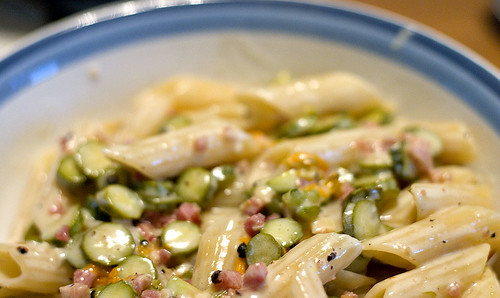
Penne con Fiori di Zucchine (Penne with Zucchini Blossoms)

CRW_9685

Last weekend, we went to the Santa Monica Farmers’ Market, because the Long Beach Farmers’ Market was closed because of the marathon. While there, I found some zucchini blossoms which aren’t usually sold in Long Beach (we have options for which vendor to buy something from but there isn’t a whole lot of variety in types of produce). I spent most of the week trying to make something with them but we kept getting side tracked with other options for dinner (we, uh, mostly ate out this week).

I had never actually eaten zucchini blossoms before but they always looked good on television (I have a confession to make: I watch way too much of Molto Mario). So I had no idea if I’d like them or what the best way to prepare them was. So I just picked something that looked reasonably good. I also needed something where the pickier eater in the family would have something to eat (it bothers me when she makes instant macaroni & cheese or a microwavable pizza when I’m at home) no matter what.

CRW_9676

So I ended up making pasta because at worst we could eat the pasta. And the pasta was quite good. It was good enough that this dish would be good without the zucchini blossoms. Angela described it as being both light and heavy at the same time and I’d have to agree. It had body but it wasn’t overly heavy and filling. It was really just a nice pasta dish.

I did like the zucchini blossoms but the blossoms themselves seem to get lost in the sauce of this dish. I believe they add flavor but I’m not sure if this is the best use of the zucchini blossoms themselves (next time I find them I may try stuffing and frying them).

CRW_9682

Penne con Fiori di Zucchine (Penne with Zucchini Blossoms)
Adapted from Trattoria Cooking

6 small zucchini flowers with small zucchini attached
2 tbsp olive oil
1/2 tbsp unsalted butter
2 oz. panchetta, diced
1 garlic clove, diced
1/2 cup dry white wine
2 tbsp chicken broth
1/2 cup heavy cream
salt and black pepper
1/2 pound penne
1/4 cup parmesan cheese

  1. Separate the flowers from the zucchini. Remove the stamen (the part inside the flower) and any remaining stem from the flowers and zucchini. Rinse the flowers and zucchini under cold water and dry with paper towels. Cut the flowers into quarters lengthwise. Slice the zucchini thinly.
  2. Cook the pasta in boiling salted water for 1 minute less than specified by the directions.
  3. In a large sauce pan, melt the butter with the olive oil over medium-high heat. Add the panchetta and cook until browned, 2 to 3 minutes. Add the zucchini, flowers, and garlic and cook for 1 minute.
  4. Add the wine and stir, scrapping any brown bits, until the wine is almost completely reduced, about 3 minutes.
  5. Stir in the broth and the cream. Season with salt and pepper. Simmer until the sauce is thickened about 4 minutes.
  6. Add the cooked pasta and cook for one minute more, stirring regularly.
  7. Serve with parmesan cheese.

Serves 2.

Spaghetti alla Carbonara

Spaghetti alla Carbonara

Doesn’t look like much does it? And, really, it’s not. Spaghetti alla carbonara is one of my default Angela-is-out-and-I-need-something-for-dinner meal. The critical path (why yes, I’m an engineer) on this dish is cooking the pasta so it isn’t really time or energy intensive. Plus, it tastes good in a comfort food sort of way.

I first tried this dish in Italy and fell in love with it in Rome. I don’t remember the name of the restaurant (I know it’s in a guidebook at home) but I do remember two things about it: it was by Pompey’s theater (which means it was in the Jewish ghetto) and that it opened for dinner at 7:30 PM. I know this second part because I showed up at 7:00 PM and was told that I would have to wait until 7:30 PM. So I waited and I was glad I did as I had the best spaghetti alla carbonara that I’ve ever had.

My version is not as good as that served in Rome. I’ve really had trouble finding a satisfactory recipe. Most recipes say that the pasta will cook the eggs in a bowl. And they’re wrong (possibly dangerously as the eggs don’t really cook). Some recipes say to add cream. Again, they’re wrong; the real dish doesn’t have cream. And serving it with a raw egg may be trendy (I think that’s how Mario Batali serves it at his restaurants) but it’s not particularly appetizing to me.

CRW_9593

My thoughts are that it should be creamy but that the eggs should make it creamy. The only way I’ve found to do that is to slowly cook the eggs with the pasta as if making a custard. Is it authentic? I have no idea (it’s probably not) but it tastes good to me and fulfills my memories of the dish.

The recipe is loosely based on one from a book I bought in Italy, All the Recipes, Pasta of Italian Cuisine. However, the technique of the recipe is pretty much my own creation and I’ve modified the ingredients list a bit. I’ve only ever used panchetta, but I’m sure it would be good with guanciale (more authentic) or even bacon (what’s not good with bacon?). Also, when the recipe says to stir constantly, do so or you’ll end up with scrambled eggs (which, while it may be good, is not spaghetti alla carbonara). Finally, the recipe as listed only serves 1 because Angela doesn’t like it. I’ve also found that the final step of cooking the egg and pasta together seems to work better when there’s less of it. The recipe could easily be multiplied to whatever number of portions you’d like (or depending how hungry you are; this isn’t a lot of food for one person).

CRW_9594

Spaghetti alla Carbonara

4 oz pasta
1 tbsp olive oil
1 oz panchetta, diced
1 garlic clove, peeled
1 egg and 1 egg yolk
4 tbsp Pecorino Romano cheese
salt and pepper

  1. Bring water to a boil, add salt, and cook the pasta. Under cook it by one minute.
  2. While the pasta cooks, in a sauce pan (preferably nonstick), add the olive oil and the garlic clove. Turn the heat to medium. When the oil is hot, add the panchetta and cook until it is browned but not completely cooked (the panchetta will cook for a minute after the heat is off).  Remove the garlic clove.  Turn off the heat.
  3. In a bowl, whisk together the egg, egg yolk, 2 tbsp cheese, salt, and pepper to taste.
  4. When the pasta is finished cooking, strain it and add it to the sauce pan. Pour the egg mixture over the pasta. Prepare a serving bowl. While constantly stirring, turn the heat to medium and cook. When the egg mixture just begins to solidify on the bottom of the pan, turn off the heat and pour to pasta into the prepared serving dish.

Serves 1.

    Eggplant Parmesan

    Eggplant Parmesan

    I have a confession. I had never had eggplant parmesan (does parmesan need to be capitalized? my spell checker wants it to be; it’s the anglization of parmigiano meaning something from Parma, Italy) before. I love Italian food (I believe it’s authentically Italian as I’ve seen it in Italy and Wikipedia backs me up) as well as the Italian-American versions with chicken or better yet veal so you’d think that I’d have tried it before now.

    However, until very recently I was of the opinion that eggplant was ‘icky.’ A certain movie with an animated rat (which, by the way, I haven’t gotten around to seeing yet) made me decide that I needed to at least reevaluate my opinions of eggplant. At the time, I made a simple version of ratatouille and actually liked it (I spared Angela from even trying it as I was almost positive she’d give it a thumbs down).

    Risen Bread Dough

    When it comes to Italian food, I’m much more in my comfort zone and am much more likely to modify a recipe to suit my tastes (or what I think my tastes will be). I used Marcella Hazan’s recipe as a basis and it turned out to be different than I was expecting. For some reason, I expected there to be bread crumbs on the eggplant but this recipe did not call for them (although that would be an interesting variation to try in the future). It was also layered and I was expecting a single layer of eggplant. I suppose I was expecting chicken parmesan where eggplant has replaced chicken.

    As to the recipe, it was pretty good. I don’t think I soaked the eggplant in salt long enough as it was still quite bitter (unlike the afore mentioned ratatouille) and didn’t seem to have exuded a significant amount of liquid. I only had dry basil (the original recipe called for fresh but the basil plant I bought a few months ago is pretty much dead; I have a brown thumb) but it would probably be better replaced with fresh basil added as part of the layering stage. Because I used less eggplant, I ended up with fewer layers. Also, as you can tell in the picture above, the dish did not retain its structural integrity (wow, that brought out my inner engineer) when it was removed from the serving dish.

    And Angela hated it (but what do you expect, she hates vegetables).

    Eggplant Parmesan
    Adapted from Essentials of Classic Italian Cooking

    1 medium Italian eggplant (the type that vaguely resembles a purple banana)
    salt
    1/2 cup all purpose flour
    4 tbsp olive oil
    3 roma tomatoes
    1 tsp dry basil
    2 oz mozzarella cheese, thinly sliced
    1/4 cup grated parmesan cheese

    1. Preheat oven to 400°F.
    2. Cut the eggplant into 3/8″ thick slices (for my eggplant, it resulted in about 4 different slices). Place in a collander over the sink and sprinkle both sides generously with salt. Allow to sit for at least half an hour (if my experience is any guide, probably closer to an hour to remove more of the bitterness).
    3. Run the tomatoes through a food mill (if you don’t have one, buy one; or skin, seed, and dice the tomatoes). Add 1 tbsp of olive oil, the tomatoes, 1 tsp salt, and the basil to a sauce pan. Simmer until reduced to a thicker consistency.
    4. Dry the eggplant slices in paper towels. Dredge the eggplant in the flour.
    5. Heat 3 tbsp of olive oil in a skillet over medium-high heat until just before smoking. Add the eggplant, cooking in batches if needed, until browned on both sides. About 2 to 3 minutes per side.
    6. Grease a heat proof baking dish. Add a layer of eggplant, add a layer of mozzarella cheese, layer with tomato sauce, and sprinkle generously with parmesan cheese. Add another layer of eggplant, top with tomato sauce, and sprinkle with parmesan cheese.
    7. Bake for 20 minutes at 400°F.

    Serves 2.