Archive for the 'Recipe' Category


Fettucine con Salsa di Gorgonzola (Fettucini with Gorgonzola Sauce)

Fettucine with Gorgonzola Sauce

Angela left me to my own devices this past week as she was out of town attending a wedding.  Some may look at this as a tragedy; I merely look at it as an opportunity to eat things she doesn’t like.

In college, I independently developed something similar to this recipe.  It developed as an elaboration of a fettucine alfredo recipe I found in a Betty Crocker cookbook that was owned by my roommate.  I no longer make that recipe as I’ve moved on to better and (to my thinking at least) more authentic recipes.

However, there’s a bit of a story to that fettucine alfredo recipe.  It was one of the first things I ever cooked from a published recipe.  But, more importantly to me at least, was that it was the first thing I ever cooked for Angela.

As documented in the about page, this was an effort to impress here. And apparently it worked.

But that has very little to do with this recipe as Angela doesn’t like Gorgonzola cheese (or really any blue cheese) which is why I made this recipe when she was gone. It’s a rather simple recipe. The most time was taken up in making the pasta.

My pasta making technique has been modified a bit now.  I tend to add a little bit of olive oil and salt to the dough.  I’m not sure if I can taste a difference or not but it’s been working for me.  I also use large eggs now as I’ve started buying the dark yolk eggs from Trader Joe’s.  If anything, the dough has been easier to work with with large eggs as opposed to extra large eggs.

The Gorgonzola sauce is quite good if fattening.  The flavor of the Gorgonzola definitely ripens as it is allowed to sit at room temperature but the sauce itself is very well balanced.  It went well, for me, with a 2005 Palmina Dolcetto.

Homemade Pasta

Fettucine con Salsa di Gorgonzola (Fettucini with Gorgonzola Sauce)
Adapted from Essentials of Classic Italian Cooking

1/4 lbs. Gorgonzola, left at room temperature for at least 6 hours
1/3 cup whole milk
3 tbsp butter
salt
1/2 cup heavy cream
1 1/4 lbs. fresh fettuccine (preferably homemade)
1/3 cup grated parmesan cheese

  1. In a large saucepan, place the gorgonzola, milk, and butter over low heat.  Stir with a wood spoon, breaking up the gorgonzola.  Cook for a minute or two or until the butter melts.
  2. Add the heavy cream and increase the heat to medium-low.  Cook until the heavy cream has thickened slightly, about 2 minutes.
  3. Cook the pasta in boiling salted water until slightly undercooked.  Add the pasta to the sauce.
  4. Cook the sauce for 1 minute more, stirring in the pasta.
  5. Stir in the parmesan cheese.
  6. Serve immediately with extra grated parmesan cheese on top.

Serves 4.

Mock Porchetta

Mock Porchetta Served

Ever since I had heard of porchetta, I have lusted after it. A whole pig stuffed with garlic, herbs, and other seasonings? Yes, please! It’s almost like an Italian version of barbeque.

Despite my pretensions, there’s no way I’m going to cook a whole pig, particularly in my small apartment kitchen. I don’t think it would fit in my oven for one.

Mock Porchetta Cooking

This isn’t a real porchetta. Given I have no baseline for real porchetta, I don’t even know how it compares. It is, however, good and I think it might be a good approximation.

I waited to make this until I had a “special occasion” (a.k.a. when it would be more than just Angela and I for dinner). The opportunity presented itself when my parents came to visit.

This is actually a great meal to make when having company. While it takes a long time to cook (and does require advanced preparation), it requires little in the way of real work. Most of the cooking is done unattended and only needs to be checked on once every hour or so. Having a whole meal in one dish doesn’t hurt.

The only proof you should need that the mock porchetta is good is that my mother asked for a copy of the recipe.

I served the mock porchetta with a homemade baguette and a bottle of 2004 Dopff & Irion Riesling Schoenenbourg. Dessert was homemade orange ice cream.

Mock Porchetta seasoned and tied

Mock Porchetta
Adapted from The Zuni Cafe Cookbook: A Compendium of Recipes and Cooking Lessons from San Francisco’s Beloved Restaurant

1 2-1/2 to 3 lbs. pork butt roast
salt
1 tbsp capers, rinse, soaked, dried and chopped
1 tsp chopped lemon zest
3 garlic cloves, coarsley chopped
12 fresh sage leaves, crushed and chopped
2 sprigs rosemary, leaves stripped and chopped
2 tsp fennel seeds, crushed
1 1/2 tsp ground black pepper
2 lbs. peeled and sliced potatoes, carrots, and red onions
olive oil
2/3 cup pork stock or chicken stock
2 tbsp dry vermouth

  1. In a bowl, combine the capers, lemon zest, garlic, herbs, fennel seeds, and pepper in a small bowl. Mix well.
  2. Trim all but 1/4″ of fat off the sides of the pork butt. Cut into the pork butt to open up as much surface area as possible while only opening up natural seams in the meat. (If you use a portion near the bone, the natural pocket left by the bone may suffice for this portion).
  3. Season the inside of the pork with salt evenly. Rub the herb mixture all over the inside of the pork. Season the outside of the pork.
  4. Tie the pork to form a uniform shape.
  5. Cover the pork and allow to sit in the refrigerator for 1 to 3 days.
  6. Remove the pork an hour before cooking to allow it to come to room temperature.
  7. Preheat the oven to 350°F.
  8. Toss the vegetables in a minimum of olive oil, so that they are barely coated. Season with a few pinches of salt.
  9. Heat a dutch oven over medium heat until hot. Add the pork roast and surround with the vegetables.
  10. Place in the oven and bake for 1 hour.
  11. After an hour, turn over the meat and rotate the vegetables.
  12. Bake for 1 hour more.
  13. Add 1/3 cup of the stock, return to the oven, and bake for 15 to 30 minutes more, to 185°F.
  14. Remove from the oven. Remove the pork and vegetables, cover with aluminum foil.
  15. Deglaze the dutch oven with the vermouth and remaining stock. Bring to a simmer and scrape any browned bits off the bottom of the pan. Simmer to reduce the sauce slightly.
  16. Slice the pork and serve garnished with the vegetables and sauce.

Serves 4 to 6.

Sanguinaccio (Bittersweet Chocolate Pudding)

CRW_1927

Chocolate pudding invariably brings back memories of childhood. I doubt that there have ever been children that dislike pudding. It’s got a cream texture and it comes in so many flavors that there has to be one that you enjoy.

During my childhood, I didn’t get the pudding in the now familiar pudding snack form (which my wife still likes). My mom would make pudding from the Jello box (and never the generic brand).

Every few months, I’d notice that there was a bowl of pudding chilling in the refrigerator and I knew it would appear on the table after dinner for dessert (which, despite the fact that he rarely made it, my dad insisted on presenting). Or better yet, I’d get to eat it for breakfast.

CRW_1815

This, however, is not the pudding of my childhood. It’s much richer and more chocolaty. The spices also make it a bit different. But, at it’s core, it’s still chocolate pudding.

I failed to properly melt all the chocolate in the pudding so there were small chunks floating around. Personally, I enjoyed having a bit more texture to the pudding but it isn’t the intended effect so, assuming you want smooth pudding, make sure to stir until all the chocolate has melted.

I liked the pudding, both for dessert and breakfast. It went particularly well with some whipped cream.

CRW_1922

Sanguinaccio (Bittersweet Chocolate Pudding)
Adapted from Molto Italiano: 327 Simple Italian Recipes to Cook at Home

1 cup unsweetened cocoa powder
1/2 cup all purpose flour
2 cups sugar
4 1/2 cups whole milk
12 oz. bittersweet chocolate, chopped
1 tsp vanilla extract
1 tsp ground cinnamon

  1. In a bowl, whisk together the cocoa powder, flour, and sugar. Slowly whisk in the milk until it forms a paste than whisk in the remaining milk.
  2. Transfer the milk mixture from the bowl into a sauce pan and bring to a simmer over medium heat.
  3. Remove the milk mixture from the heat and return to the bowl. Stir in the chocolate, vanilla, and cinnamon and whisk until the chocolate is completed melted.
  4. Allow the pudding to cool to room temperature then chill in the refrigerator.
  5. Serve the chilled pudding topped with whipped cream.

Makes 10 servings.

Peach Pie

Slice of Peach Pie

Recently, I found that I had a craving for a peach pie. What’s strange about this is that I’m fairly certain I’ve never had a peach pie before.

Luckily for me, it’s peach season here in California. To my taste buds, the peaches here aren’t quite as sweet as those on the east coast; Angela merely dislikes the fact that they aren’t Georgia peaches.

I bought some peaches at the farmer’s market, mainly on a whim. I had had the peach pie craving for awhile but had failed to look for any recipes before leaving so I had to guess as to how many to buy.

I did manage to guess correctly although I’m not entirely certain I got free stone peaches. I had more trouble with slicing the first couple than I did with the rest but they still held onto their pits pretty well.

This pie ended up being everything I was looking for in a peach pie. The peach flavor showed through. The peaches held their shape (one of my father’s complaints about peach pie is that the peaches get too soft; not these peaches).

The first slice of pie was for dessert but most of the rest ended up being my breakfast (what? peaches are good for you). After writing this up, I want to make a peach pie again.

Peach Pie ready to be covered

Peach Pie
Adapted from Deborah Tyler via The New York Times Dessert Cookbook

5 or 6 large free stone peaches, peeled, pitted, and sliced 1/2″ thick
1/4 cup cornstarch
1 tbsp unsalted butter, softened
3/4 cup plus 2 tsp sugar
prepared butter pastry

  1. Preheat oven to 450ºF.
  2. Mix the peaches, cornstarch, butter, and 1/4 cup sugar in a bowl until combined.
  3. Divide the dough in half and roll out the first piece into an 11″ diameter circle. Place the dough into a 9″ pie pan and cut off any extra.
  4. Spread the peach mixture into the pie crust.
  5. Roll out the second dough half into a circle 11″ in diameter. Place the dough on top of the pie, crimping the edges, and cutting off any extra.
  6. Make 6 cuts on top of the pie crust to allow venting.
  7. Sprinkle the remaining sugar over top of the pie crust.
  8. Bake in the oven for 10 minutes, then reduce the heat to 350ºF, and bake for 50 more minutes.
  9. Serve either warm or cooled.

Makes 1 pie.

Peach Pie


Butter Pastry
Adapted from Deborah Tyler via
The New York Times Dessert Cookbook

1 cup butter, softened
1/2 tsp salt
3 cups flour

  1. Place all ingredients in a food processor. Pulse until the mixture has the consistency of cornmeal.
  2. Add 3 to 4 tbsp of water and pulse until the mixture forms a ball.
  3. Knead the dough briefly so that the dough comes together.
  4. Wrap in plastic wrap and refrigerate until ready to use, at least 15 minutes.

Makes enough crust for one 9″ double crust pie

Pollo al Diavolo (The Devil’s Chicken)

Pollo al Diavolo

Some recipes manage to surprise me. Pollo al diavolo is a fairly common recipe for Italian (and Italian-American) cookbooks. Usually, it’s just a spicy chicken that’s either sautéed or braised. It’s rarely bad but it’s become normal and expected.

This recipe was not at all what I was expecting. To be honest, I was sold on this recipe merely because the picture of it looked good (unfortunately, I don’t think my pictures turned out as well). I saw the name and recognizing that it implied spicy food, I figured it’d make a good dinner.

Except, this was significantly different than any version of Pollo al diavolo I had ever had. Most are spicy through red pepper flakes; this is spicy through the black pepper it’s cooked with as well as a spicy oil (olio picante) that you can optionally drizzle over top (I chose to, Angela didn’t).

Despite the relatively short period of time that the black pepper mixture is on the chicken, the pepper taste is absorbed by the chicken. Unlike my experiences with steak au poivre (which I would happily accept as mistakes in my cooking), the pepper did not overpower the taste of the chicken but merely complemented it. I found that the olio picante also complemented the chicken but it tastes primarily of jalapeños with a surprisingly muted heat.

The brining of the chicken is my addition to this recipe (it wasn’t in the original). It did help to make the chicken nice and juicy. If I were to make it again (and I probably will so this can be considered a note to myself), I’d probably add crushed black pepper corns to the brine.

I enjoyed the parsley salad although the parsley portion of it was my least favorite. I’d be happy to substitute a different leafy green for the parsley and I can’t imagine it wouldn’t improve the outcome. The vinaigrette nicely contrasts with the spiciness of the chicken.

As I said, my overall impression of this was surprise. It was less spicy than I expected and the spice was completely different. It’s a much more elegant version of a normally pedestrian dish.

Roast Pollo al Diavolo

Pollo al Diavolo (The Devil’s Chicken)
Adapted from Molto Italiano: 327 Simple Italian Recipes to Cook at Home

Brine:
1 gallon water
1 cup/225 grams kosher salt
1/2 cup/125 grams sugar

1 three-to-five lbs. chicken
1/4 cup ground black pepper
6 tbsp olive oil
2 tbsp dijon mustard
1 cup chopped Italian parsley
1 red onion, thinly sliced
12 cherry tomatoes, halved
1 tbsp red wine vinegar
olio picante

  1. In a sauce pan over high heat, combine all the brine ingredients. Bring to a simmer, stirring until the salt and sugar are dissolved. Remove from heat and allow to cool to room temperature. Put the brine in the refrigerator and allow to chill. Add the chicken and brine for 8 to 12 hours. Remove the chicken from the brine, rinse, and pat dry with paper towels. Allow the chicken to rest in the refrigerator for at least 8 hours.
  2. Preheat the oven to 400°F.
  3. Truss the chicken and baste it all over with the olive oil.
  4. Place in a roasting pan and roast in the oven for 40 minutes.
  5. Combine the 1/4 cup black pepper, a pinch of salt, and the mustard and whisk together. Drizzle in 1 tbsp of olive oil, whisking until blended.
  6. Remove the chicken from the oven and brush the chicken with the pepper-mustard mixture all over. Return the chicken to the oven for another 30 minutes.
  7. Remove the chicken from the oven and allow to rest for 10 minutes.
  8. Meanwhile, combine the parsley, onion, tomatoes, vinegar, 3 tbsp olive oil, salt and pepper in a bowl and toss well.
  9. Carve the chicken and serve it with the parsley salad and drizzle it with the olio picante.

Serves 4.

Parsley Salad


Olio Picante (Spicy Oil)
Adapted from
Molto Italiano: 327 Simple Italian Recipes to Cook at Home

1 cup olive oil
4 jalapeños, seed and diced
1 tbsp red pepper flakes
1/2 tbsp Spanish smoked paprika

  1. In a saucepan, combine all the ingredients and heat until the oil reaches 175ºF.
  2. Remove from the heat and allow to stand overnight.
  3. Strain the solids out of the oil.
  4. The oil will keep for up to 3 weeks in a cool, dark place.

Makes 1 cup of oil.

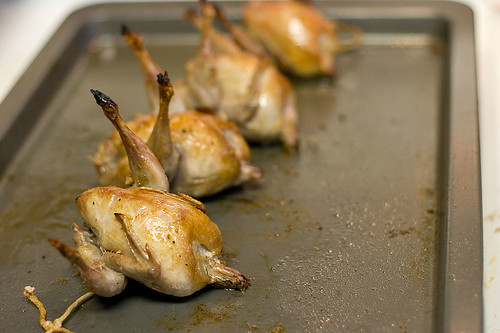
Roast Quail

Roasted Quail

The first time that I had quail was at Ma Cuisine in Beaune, France. One of their wait staff helpfully translated the menu for us in real time as the combination of foreign language and hand-written menu proved indecipherable to Angela and me. I ordered the quail mainly because I had never had it before and their reputation implied that it would be good.

And they truly managed to exceed my expectations that night. Quail is a more flavorful and slightly gamier version of turkey without turkey’s propensity to be overcooked and dry.

The small size is both a blessing and a curse: it’s very easy to prepare exactly as much as is needed no matter the number of guests but it’s all significantly difficult to eat. Following the recommendation in the cookbook, we simply ate with our hands.

This recipe is a bit different than the one that I had in France but it’s still quite good. The quail I had in France was larger than the quail I’ve found in the United States; in France, I was served a single quail as an entrée whereas in the U.S. two quail are usually more appropriate. However, if you aren’t particularly hungry or don’t want a lot of protein, a serving of a single quail would work quite well.

Quail, simply by its nature, is not an every day food. It’s too exotic for that. But, for a special occasion, quail can provide an elegant dinner.

Roasted Quail

Roast Quail
Adapted from The Zuni Cafe Cookbook: A Compendium of Recipes and Cooking Lessons from San Francisco’s Beloved Restaurant

4 six oz. cleaned quail
salt and pepper
4 sprigs of thyme
4 tbsp butter, softened

  1. Twenty-four hours in advance, dry the quail with paper towels and then season all over with salt and pepper. Remove the thyme leaves from the sprigs and sprinkle the thyme leaves over the quail. Refrigerate for 24 hours.
  2. Preheat the broiler.
  3. Dry the quail and remove any thyme remaining on the birds. Tie a string around the quail to keep the legs tucked back and pointed up.
  4. Place the quail breast side up on a shallow baking sheet and broil 4″ from the broiling element for 5 to 6 minutes or until the breasts are well browned.
  5. Turn the quail to one side and broil for 1 minute. Turn the quail onto the other side and broil for 1 more minute.
  6. Turn the quail breast side up and broil for 1 final minute. Remove from the broiler.
  7. Allow to rest briefly, then serve.

Serves 2.

Semolina Bread

I have no idea what the slices in the side are supposed to do

Angela has been hinting to me for several years that I needed to try to make semolina bread. It’s not that I was against making it, it was just that I never got around to it. Whenever I thought about it, I’d look at the recipe and realize that it required a starter and that I simply didn’t have the time to get it ready for dinner. So I kept putting it off.

A combination of factors led to me actually making the semolina bread but the primary reason was that I had to go to the opposite side of the country for work the next week and I wanted to make something special for Angela before I left. Given that she was out all Saturday, meant that I could sit around and make the various sponges and doughs required without being dragged out of the apartment by a girl with wanderlust.

As a bit of an aside, I should mention that I make bread fairly frequently to have with dinner. I don’t do a particularly complicated bread but it tastes pretty good (and someday I may post the recipe on here). It doesn’t use a sponge or a starter. I let it rise two times if I have the time available. It’s never exactly the same any time but everyone who’s had it likes it.

Making the semolina bread was quite different than what I usually make. The sponge was easy enough: just mix the yeast, water, and bread flour together and let it sit. For the actual dough, I make it in a food processor for the first time (I usually use a KitchenAid mixer but I recently got a Cuisinart food processor and thought I’d give it a try). The dough came together quite well in the food processor and didn’t give me any difficulty. I was surprised by how quickly the dough was ready, kneading included. It almost seems wrong for the kneading to only take 20 seconds. Of course, you can always switch to kneading by hand.

The bread itself was good but I don’t think I could eat it every day. It was almost too flavorful. The semolina becomes one of the dominant flavors in the bread. I wonder if it might be better if it was made without a starter.

It's hard not to feel a sense of accomplishment merely because your dough has risen

Semolina Bread
Adapted from Baking with Julia: Savor the Joys of Baking with America’s Best Bakers

The Sponge:
1 cup warm water
1 tsp dry yeast
1 cup bread flour

The Dough:
1/2 to 3/4 cup bread flour
3/4 cup semolina flour
1 tbsp kosher salt
1 tbsp olive oil

  1. To make the sponge, pour the water into a bowl and whisk in the yeast. When the yeast has dissolved, stir in the flour. Cover and place in a warm place until it doubles in volume, about 2 hours.
  2. In the bowl of a food processor fitted with the dough blade, put the sponge, 1/2 cup of the flour, the semolina flour, the salt, and the olive oil. Pulse until the dough forms a ball. If the dough does not form a ball, add more flour by the tablespoonful then pulse, until the dough does form a ball.
  3. After the dough has formed a ball, let the dough rest for 5 minutes then run the food processor for 20 seconds straight to knead the dough.
  4. Remove the dough from the food processor and place in a well oiled bowl. Cover the bowl and put it in a warm place until the dough doubles in volume, about 2 hours.
  5. Remove the dough from the bowl and place it on a floured work surface. Pat the dough into an oval shape and then roll it gently to form a plump loaf.
  6. Transfer the loaf to parchment lined baking sheet and cover. Allow it to rest until it doubles in volume, about 2 hours.
  7. Preheat the oven to 400ºF.
  8. After the loaf has doubled in size, cut marks into the side of the loaf at a 30º diagonal to vertical, spaced at 1″ intervals.
  9. Bake for 35 to 40 minutes or until the bread is golden brown.
  10. Allow to cool and then serve.

Makes 1 loaf.

Gnocchi di Patate (Potato Gnocchi)

I think they tasted better than they look (aka one of those foods)

I owe it to a college roommate to make this recipe. He loved gnocchi and would order them in any Italian restaurant that he could. When I went to Italy, I was determined to try them but, for whatever reason, I didn’t like the ones that I had. In retrospect, I don’t think it was the gnocchi that I disliked. But I did send him an email with my conclusion and he was incredulous. I figured gnocchi deserved another chance.

And, while I hate admitting I’m wrong, I was and my roommate was right. Gnocchi are good. They remind me most of dumplings. I like the lightness and fluffiness of them.

They also seem to be the ultimate poor food. When you can’t afford flour for pasta, you have to substitute potatoes. But, given that they’re good, who am I to complain?

There are a number of possible sauces to use with the gnocchi but I settled on a simple tomato sauce. This one is particularly good (and easy).

Unfortunately, the gnocchi really liked to stick together

Gnocchi di Patate (Potato Gnocchi)
Adapted from Molto Italiano: 327 Simple Italian Recipes to Cook at Home

3 lbs. russet potatoes
2 cups all-purpose flour
1 large egg
1 tsp kosher salt

  1. Put the potatoes in a large pot and cover with water. Bring to a boil, reduce the heat to a low boil, and boil for 45 minutes or until the potatoes are tender. Drain the potatoes.
  2. Peel the potatoes and then run them through a food mill onto a flat work surface.
  3. Make a well in the center of the potatoes and sprinkle the potatoes with the flour.
  4. Add the egg and salt to the well in the potatoes.. Use a fork to slightly beat the egg.
  5. Using the fork, slowly incorporate the potato into the egg.
  6. Once the potato is fully incorporated into the egg, knead the dough until it forms a ball. Continue kneading for 4 minutes.
  7. Divide the dough into sixths. Roll each piece of dough into a rope 3/4″ in diameter. Cut the rope into 1″ lengths. Roll each piece down the back of a fork to create the ridges.
  8. Boil the gnocchi in copious salted water until the float, about 1 minute. Drain the gnocchi.
  9. Toss the gnocchi with warmed sauce and serve.

Serves 4.

Herb-Brined Roast Chicken

It's surprisingly difficult to photograph a roast chicken

Currently, whenever I think of roast chicken, I think of the roast chicken I shared with friends, in the rain, in Versailles, France. We had just taken the train in from Paris to visit the eponymous Château. We were hungry and our guide book directed us to the local farmer’s market. We eventually settled on a roast chicken and a loaf of bread. We huddled under an archway and, after the first couple bites, literally tore the chicken apart. I don’t know if it was the setting, the company, or if the chicken was as good as I remember, but it was the best roast chicken I may have ever had.

But, really, is there a need for yet-another-roast-chicken recipe out there? Has there ever been a cookbook published without one? Hyperbole aside, there certainly are enough out there. I’ve even posted one.

So why another one? Well, I originally used this brine for a turkey at Thanksgiving (if you wish to do so, increase the brine time to 24 hours). The turkey turned out excellently so I thought I’d apply to a chicken in the future.

And here we are then. I had a craving for roast chicken and I decided to share it with the rest of the world (or the limited portion of it that reads this blog).

The brine is not for the faint of heart (or pocketbook). I’m half convinced I spent more on the brine than on the chicken (and it was an organic chicken!). I wouldn’t use this as an everyday brine but it works well for special occasions. I plan to use the brine again next Thanksgiving.

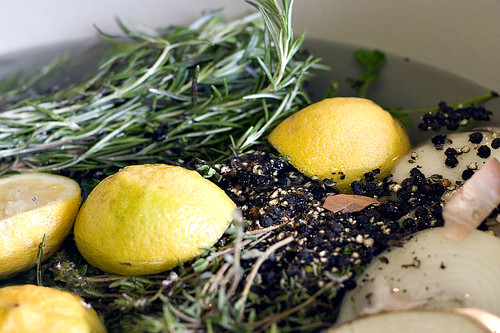
For some reason, I feel like I'm wasting everything that goes into the brine

Herb-Brined Roast Chicken
Adapted from Charcuterie: The Craft of Salting, Smoking, and Curing

Brine:
1 gallon water
1 cup kosher salt
1/2 cup sugar
1 bunch fresh thyme
1 bunch fresh rosemary
1 bunch fresh parsley
2 bay leaves
1 head garlic, cut in half horizontally
1 onion, sliced
3 tbsp black peppercorns, crushed
2 lemons, halved

1 whole 3-to-4 lbs. chicken

  1. Combine all the brine ingredients in a large pot; squeeze the lemons as they are added. Bring to a simmer over high heat to dissolve the salt and sugar. Remove from the heat. Allow to cool to room temperature and then refrigerate until chilled.
  2. Add the chicken to the brine and weigh it down with a plate to keep it submerged. Allow to brine for 8 to 12 hours.
  3. Remove the chicken from the brine, rinse well, and dry with paper towels. Let it rest in the refrigerator for 24 hours.
  4. Remove the chicken from the refrigerator an hour before cooking.
  5. Preheat the oven to 450ºF.
  6. Roast the chicken in a roasting tray until it reaches an internal temperature of 160ºF. Remove from the oven and allow to rest for 15 minutes.
  7. Serve immediately.

Serves 3 to 4.

Garlic Kosher Dill Pickles

I can't believe I added the salt the way I did

I absolutely love pickles. And to me, the best pickles are dill pickles. I’ve been known to pick something different for lunch simply because it comes with pickles. One of the best things that the cafeteria at my workplace did was to add sliced dill pickles to the make-your-own sandwich bar.

I’ve made refrigerator dill pickles in the past (meaning last year) and, while quite good (some of my friends lust after them), there was something not quite with them. Either they ended up too spicy (they had jalapeños in the) or too sweet or too sour. Or they just weren’t perfect.

So I’ve started my own personal search for the perfect dill pickle recipe. I figured that if refrigerator pickles are in some sense a modern short cut, I’d go back to a natural fermentation recipe instead of only using vinegar to pickle them. I also wanted to can them so that they’d be easy to give out and would take up room in my refrigerator.

Except I screwed up. I realized part of the way through preparing these to be canned that I was going to run out of brine. I do know that when canning acidity level is very important so I just mixed up some more brine as was done in the third step of the recipe. Anyone spot my mistake yet? At some level, I knew it as soon as I did. See, I added in the salt again this time. When I opened the first jar, the pickles were intolerably salty. So, if you make these and run out of brine, leave out the salt.

So why did I post this? Partially, so Angela can no longer claim I only posts the successes. But I also didn’t screw up all the jars and, when I tried the pickles prior to canning, they were really quite good. Were they the best ever? I don’t know yet. I’ve already got another batch of dill pickles in my fridge fermenting away.

So, if you like pickles, stay tuned as I try to find my favorite recipe.

I kept walking into our living room and wondered what smelled good, then realized it was the pickles brining

Garlic Kosher Dill Pickles
Adapted from Ball Complete Book of Home Preservation 400 delicious and creative recipes for today

5 lbs. pickling cucumbers
6 tbsp pickling spice
2 bunches dill
3/4 cup kosher salt
1 cup white vinegar
8 cups water
3 garlic cloves

  1. Rinse the cucumbers. Cut the ends off the cucumbers and then cut them into 1/4″ thick slices.
  2. In a large ceramic, stainless steel, or glass container, place half of the pickling spice and one bunch of dill. Place the cucumbers on top.
  3. In a large stainless steel pot, add the salt, vinegar, and water. Bring to a boil and dissolve the salt. Remove from the heat and allow to cool.
  4. Pour the pickling liquid into the crock. Place the remaining pickling spice and dill and the garlic on top. Place a plate on top of the cucumbers and then a jar filled with water on top of the plate.
  5. Put the container in a cool dry place and cover it with a tea towel. Allow it to ferment for 2 to 3 weeks or until the cucumbers have achieved a pickled flavor. Remove any scum from the top of the container every day.
  6. Prepare the canner, jars, and lids.
  7. Drain the pickles, reserving the brine, and remove the dill, pickling spice, and garlic. Bring the brine to a boil in a stainless steel pan and boil for 5 minutes.
  8. Pack the pickles into the jars leaving 1/2″ head room. Pour the hot brine into the jars to cover the pickles leaving 1/2″ head room. Secure the lids onto the jars.
  9. Process the jars in a boiling water canner for 10 minutes, allow to cool, and then store.

Makes about 8 pint jars.


Homemade Pickling Spice
Adapted from Ball Complete Book of Home Preservation 400 delicious and creative recipes for today

1 cinnamon sitck, broken into pieces
5 bay leaves, crushed
2 tbsp mustard seeds
1 tbsp whole allspice
1 tbsp coriander seeds
1 tbsp black peppercorns
1 tbsp ground ginger
1 tbsp dill seeds
2 tsp cardamom seeds
2 tsp red pepper flakes
1 tsp whole cloves

  1. Combine the ingredients together and mix well. Store in a sealed container.

Makes about 1/2 cup