Posts Tagged 'Recipe'


Chocolat Tarte de Rue Tatin

Chocolat Tarte de Rue Tatin

The first time that I saw this recipe I just knew that I had to make it some day. It combines two of my favorite things for desserts: tarts and chocolate.

I kept forgetting about the recipe and refinding it when I ended up flipping through the cookbook. The idea of making this has been floating through my head for over a year now. I had finally decided to make it with the extra tart dough from the Meyer Lemon Tart but the dough wasn’t really workable when I removed it from the freezer so I had to discard the tart dough. However, by that point, I had already committed to making it and decided to make a fresh tart dough fo rit.

I’d like to say that it was then a transcendental experience upon eating this after such a wait, but it was merely good. It managed to be chocolately but not overwhelmingly so. The chocolate was at a good intensity and it wasn’t at all sweet. What I really noticed was that the chocolate seemed a bit dry. This is probably because I’m mostly used to chocolate desserts being sweeter than this one.

I should probably confess that we didn’t finish eating the tart.  It wasn’t possible for me to really eat a lot of the tart at once and it was too much chocolate for Angela.  It didn’t help that shortly after I made it I had to travel to the east coast for work.

I would reserve this tart for only the true chocolate lovers.

Diced Chocolat

Chocolat Tarte de Rue Tatin
Adapted from The Great Book of Chocolate

1/3 cup heavy cream
16 oz. bittersweet chocolate, chopped
4 large eggs, at room temperature
one 10″ prebaked tart shell

  1. Preheat the oven to 350ºF.
  2. Warm the heavy cream in a large saucepan until the edges begin to bubble. Remove from the heat.
  3. Stir the chocolate into the heavy cream until the chocolate has completely melted. Allow to cool to room temperature.
  4. Whisk the eggs into the chocolate one at a time.
  5. Pour the chocolate mixture into the pie crust and smooth out as much as possible.
  6. Bake for 15 to 20 minutes or until the filling is set but not too firm.
  7. Allow to cool to room temperature and serve with whipped cream.

Makes 10 to 12 servings.


Pâte Sucrée
Adapted from
The King Arthur Flour Baker’s Companion: The All-Purpose Baking Cookbook

1 1/4 cups (5 1/4 oz.) all-purpose flour
1 tsp nonfat dry milk (optional)
1/4 cup sugar
1/4 tsp salt
8 tbsp butter, cold, cut into tablespoons
1 large egg yolk
1 tsp vanilla extract
1 tbsp water

  1. Combine the flour, dry milk, sugar, and salt in the bowl of a food processor fitted with the metal blade. Pulse several times to mix the dry ingredients.
  2. Add the butter and pulse until the mixture resembles coarse crumbs.
  3. Add the egg yolk, vanilla, and water and pulse until the mixture forms a ball.
  4. Remove the dough from the food processor and roll out into a round to fit the tart shell. Place the dough into the tart shell. Prick the bottom of the tart shell multiple times with a fork. Refrigerate the tart dough for at least 30 minutes.
  5. Preheat the oven to 375ºF.
  6. Place a layer of aluminum foil over the tart shell and place pie weights on top of the aluminum foil.
  7. Bake for 10 to 12 minutes or until the crust is set. Remove the aluminum foil and pie weights.
  8. Bake for 6 to 8 minutes or until the crust is browned.

Makes one 9 to 10″ tart shell

Semolina Bread

I have no idea what the slices in the side are supposed to do

Angela has been hinting to me for several years that I needed to try to make semolina bread. It’s not that I was against making it, it was just that I never got around to it. Whenever I thought about it, I’d look at the recipe and realize that it required a starter and that I simply didn’t have the time to get it ready for dinner. So I kept putting it off.

A combination of factors led to me actually making the semolina bread but the primary reason was that I had to go to the opposite side of the country for work the next week and I wanted to make something special for Angela before I left. Given that she was out all Saturday, meant that I could sit around and make the various sponges and doughs required without being dragged out of the apartment by a girl with wanderlust.

As a bit of an aside, I should mention that I make bread fairly frequently to have with dinner. I don’t do a particularly complicated bread but it tastes pretty good (and someday I may post the recipe on here). It doesn’t use a sponge or a starter. I let it rise two times if I have the time available. It’s never exactly the same any time but everyone who’s had it likes it.

Making the semolina bread was quite different than what I usually make. The sponge was easy enough: just mix the yeast, water, and bread flour together and let it sit. For the actual dough, I make it in a food processor for the first time (I usually use a KitchenAid mixer but I recently got a Cuisinart food processor and thought I’d give it a try). The dough came together quite well in the food processor and didn’t give me any difficulty. I was surprised by how quickly the dough was ready, kneading included. It almost seems wrong for the kneading to only take 20 seconds. Of course, you can always switch to kneading by hand.

The bread itself was good but I don’t think I could eat it every day. It was almost too flavorful. The semolina becomes one of the dominant flavors in the bread. I wonder if it might be better if it was made without a starter.

It's hard not to feel a sense of accomplishment merely because your dough has risen

Semolina Bread
Adapted from Baking with Julia: Savor the Joys of Baking with America’s Best Bakers

The Sponge:
1 cup warm water
1 tsp dry yeast
1 cup bread flour

The Dough:
1/2 to 3/4 cup bread flour
3/4 cup semolina flour
1 tbsp kosher salt
1 tbsp olive oil

  1. To make the sponge, pour the water into a bowl and whisk in the yeast. When the yeast has dissolved, stir in the flour. Cover and place in a warm place until it doubles in volume, about 2 hours.
  2. In the bowl of a food processor fitted with the dough blade, put the sponge, 1/2 cup of the flour, the semolina flour, the salt, and the olive oil. Pulse until the dough forms a ball. If the dough does not form a ball, add more flour by the tablespoonful then pulse, until the dough does form a ball.
  3. After the dough has formed a ball, let the dough rest for 5 minutes then run the food processor for 20 seconds straight to knead the dough.
  4. Remove the dough from the food processor and place in a well oiled bowl. Cover the bowl and put it in a warm place until the dough doubles in volume, about 2 hours.
  5. Remove the dough from the bowl and place it on a floured work surface. Pat the dough into an oval shape and then roll it gently to form a plump loaf.
  6. Transfer the loaf to parchment lined baking sheet and cover. Allow it to rest until it doubles in volume, about 2 hours.
  7. Preheat the oven to 400ºF.
  8. After the loaf has doubled in size, cut marks into the side of the loaf at a 30º diagonal to vertical, spaced at 1″ intervals.
  9. Bake for 35 to 40 minutes or until the bread is golden brown.
  10. Allow to cool and then serve.

Makes 1 loaf.

Gnocchi di Patate (Potato Gnocchi)

I think they tasted better than they look (aka one of those foods)

I owe it to a college roommate to make this recipe. He loved gnocchi and would order them in any Italian restaurant that he could. When I went to Italy, I was determined to try them but, for whatever reason, I didn’t like the ones that I had. In retrospect, I don’t think it was the gnocchi that I disliked. But I did send him an email with my conclusion and he was incredulous. I figured gnocchi deserved another chance.

And, while I hate admitting I’m wrong, I was and my roommate was right. Gnocchi are good. They remind me most of dumplings. I like the lightness and fluffiness of them.

They also seem to be the ultimate poor food. When you can’t afford flour for pasta, you have to substitute potatoes. But, given that they’re good, who am I to complain?

There are a number of possible sauces to use with the gnocchi but I settled on a simple tomato sauce. This one is particularly good (and easy).

Unfortunately, the gnocchi really liked to stick together

Gnocchi di Patate (Potato Gnocchi)
Adapted from Molto Italiano: 327 Simple Italian Recipes to Cook at Home

3 lbs. russet potatoes
2 cups all-purpose flour
1 large egg
1 tsp kosher salt

  1. Put the potatoes in a large pot and cover with water. Bring to a boil, reduce the heat to a low boil, and boil for 45 minutes or until the potatoes are tender. Drain the potatoes.
  2. Peel the potatoes and then run them through a food mill onto a flat work surface.
  3. Make a well in the center of the potatoes and sprinkle the potatoes with the flour.
  4. Add the egg and salt to the well in the potatoes.. Use a fork to slightly beat the egg.
  5. Using the fork, slowly incorporate the potato into the egg.
  6. Once the potato is fully incorporated into the egg, knead the dough until it forms a ball. Continue kneading for 4 minutes.
  7. Divide the dough into sixths. Roll each piece of dough into a rope 3/4″ in diameter. Cut the rope into 1″ lengths. Roll each piece down the back of a fork to create the ridges.
  8. Boil the gnocchi in copious salted water until the float, about 1 minute. Drain the gnocchi.
  9. Toss the gnocchi with warmed sauce and serve.

Serves 4.

Herb-Brined Roast Chicken

It's surprisingly difficult to photograph a roast chicken

Currently, whenever I think of roast chicken, I think of the roast chicken I shared with friends, in the rain, in Versailles, France. We had just taken the train in from Paris to visit the eponymous Château. We were hungry and our guide book directed us to the local farmer’s market. We eventually settled on a roast chicken and a loaf of bread. We huddled under an archway and, after the first couple bites, literally tore the chicken apart. I don’t know if it was the setting, the company, or if the chicken was as good as I remember, but it was the best roast chicken I may have ever had.

But, really, is there a need for yet-another-roast-chicken recipe out there? Has there ever been a cookbook published without one? Hyperbole aside, there certainly are enough out there. I’ve even posted one.

So why another one? Well, I originally used this brine for a turkey at Thanksgiving (if you wish to do so, increase the brine time to 24 hours). The turkey turned out excellently so I thought I’d apply to a chicken in the future.

And here we are then. I had a craving for roast chicken and I decided to share it with the rest of the world (or the limited portion of it that reads this blog).

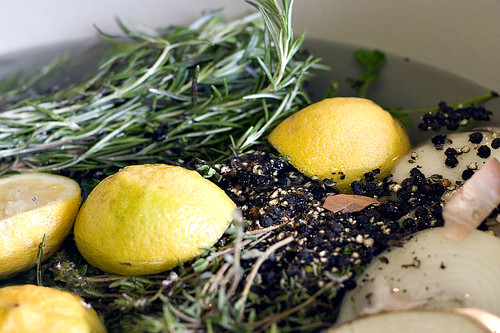
The brine is not for the faint of heart (or pocketbook). I’m half convinced I spent more on the brine than on the chicken (and it was an organic chicken!). I wouldn’t use this as an everyday brine but it works well for special occasions. I plan to use the brine again next Thanksgiving.

For some reason, I feel like I'm wasting everything that goes into the brine

Herb-Brined Roast Chicken
Adapted from Charcuterie: The Craft of Salting, Smoking, and Curing

Brine:
1 gallon water
1 cup kosher salt
1/2 cup sugar
1 bunch fresh thyme
1 bunch fresh rosemary
1 bunch fresh parsley
2 bay leaves
1 head garlic, cut in half horizontally
1 onion, sliced
3 tbsp black peppercorns, crushed
2 lemons, halved

1 whole 3-to-4 lbs. chicken

  1. Combine all the brine ingredients in a large pot; squeeze the lemons as they are added. Bring to a simmer over high heat to dissolve the salt and sugar. Remove from the heat. Allow to cool to room temperature and then refrigerate until chilled.
  2. Add the chicken to the brine and weigh it down with a plate to keep it submerged. Allow to brine for 8 to 12 hours.
  3. Remove the chicken from the brine, rinse well, and dry with paper towels. Let it rest in the refrigerator for 24 hours.
  4. Remove the chicken from the refrigerator an hour before cooking.
  5. Preheat the oven to 450ºF.
  6. Roast the chicken in a roasting tray until it reaches an internal temperature of 160ºF. Remove from the oven and allow to rest for 15 minutes.
  7. Serve immediately.

Serves 3 to 4.

Garlic Kosher Dill Pickles

I can't believe I added the salt the way I did

I absolutely love pickles. And to me, the best pickles are dill pickles. I’ve been known to pick something different for lunch simply because it comes with pickles. One of the best things that the cafeteria at my workplace did was to add sliced dill pickles to the make-your-own sandwich bar.

I’ve made refrigerator dill pickles in the past (meaning last year) and, while quite good (some of my friends lust after them), there was something not quite with them. Either they ended up too spicy (they had jalapeños in the) or too sweet or too sour. Or they just weren’t perfect.

So I’ve started my own personal search for the perfect dill pickle recipe. I figured that if refrigerator pickles are in some sense a modern short cut, I’d go back to a natural fermentation recipe instead of only using vinegar to pickle them. I also wanted to can them so that they’d be easy to give out and would take up room in my refrigerator.

Except I screwed up. I realized part of the way through preparing these to be canned that I was going to run out of brine. I do know that when canning acidity level is very important so I just mixed up some more brine as was done in the third step of the recipe. Anyone spot my mistake yet? At some level, I knew it as soon as I did. See, I added in the salt again this time. When I opened the first jar, the pickles were intolerably salty. So, if you make these and run out of brine, leave out the salt.

So why did I post this? Partially, so Angela can no longer claim I only posts the successes. But I also didn’t screw up all the jars and, when I tried the pickles prior to canning, they were really quite good. Were they the best ever? I don’t know yet. I’ve already got another batch of dill pickles in my fridge fermenting away.

So, if you like pickles, stay tuned as I try to find my favorite recipe.

I kept walking into our living room and wondered what smelled good, then realized it was the pickles brining

Garlic Kosher Dill Pickles
Adapted from Ball Complete Book of Home Preservation 400 delicious and creative recipes for today

5 lbs. pickling cucumbers
6 tbsp pickling spice
2 bunches dill
3/4 cup kosher salt
1 cup white vinegar
8 cups water
3 garlic cloves

  1. Rinse the cucumbers. Cut the ends off the cucumbers and then cut them into 1/4″ thick slices.
  2. In a large ceramic, stainless steel, or glass container, place half of the pickling spice and one bunch of dill. Place the cucumbers on top.
  3. In a large stainless steel pot, add the salt, vinegar, and water. Bring to a boil and dissolve the salt. Remove from the heat and allow to cool.
  4. Pour the pickling liquid into the crock. Place the remaining pickling spice and dill and the garlic on top. Place a plate on top of the cucumbers and then a jar filled with water on top of the plate.
  5. Put the container in a cool dry place and cover it with a tea towel. Allow it to ferment for 2 to 3 weeks or until the cucumbers have achieved a pickled flavor. Remove any scum from the top of the container every day.
  6. Prepare the canner, jars, and lids.
  7. Drain the pickles, reserving the brine, and remove the dill, pickling spice, and garlic. Bring the brine to a boil in a stainless steel pan and boil for 5 minutes.
  8. Pack the pickles into the jars leaving 1/2″ head room. Pour the hot brine into the jars to cover the pickles leaving 1/2″ head room. Secure the lids onto the jars.
  9. Process the jars in a boiling water canner for 10 minutes, allow to cool, and then store.

Makes about 8 pint jars.


Homemade Pickling Spice
Adapted from Ball Complete Book of Home Preservation 400 delicious and creative recipes for today

1 cinnamon sitck, broken into pieces
5 bay leaves, crushed
2 tbsp mustard seeds
1 tbsp whole allspice
1 tbsp coriander seeds
1 tbsp black peppercorns
1 tbsp ground ginger
1 tbsp dill seeds
2 tsp cardamom seeds
2 tsp red pepper flakes
1 tsp whole cloves

  1. Combine the ingredients together and mix well. Store in a sealed container.

Makes about 1/2 cup

English Muffins

Homemade English Muffin

I’m going to start off with a confession here. Technically, I didn’t make these; Angela did. But I assisted so I think I can claim the right to post it on here (she declined the invitation to write it up).

To me, English muffins are best represented by the Thomas’s commercial and the recitation about “nooks and crannies.” They’re not about the flavor, merely the texture. And, really, the only time people eat them is in Egg McMuffins or (much more rarely) in Eggs Benedict.

So why make them at home as opposed to buying them at the store? At the time, it actually seemed significantly easier to make them at home because it didn’t require a trip to the store. My laziness can be quite odd at times.

And, you know what, these are pretty easy to make as long as you have the time to do so. The electric mixer does all the work and all you have to do is measure.

So, the real question, are these better than store bought? By far. Where the store bought English muffins are all about the texture, these are all about the flavor. Letting the yeast raise over an appropriate time via the starter allows real flavor to develop. They made me actually like English muffins.

I did turn the first batch into Eggs Benedict (actually my first time poaching an egg or making hollandaise sauce) but we ate it too quickly to take any photographs. The next day, I did find out the true purpose of these English Muffins: spread some strawberry jelly onto them and they become almost heavenly. The flavor of the muffin perfectly compliments the jelly. I’m getting hungry just thinking about it.

These are probably the most misshapen English muffins you’ve ever seen. Apparently, there’s a device called an English muffin ring that can be used to make them round. Like many similar specialized equipment, I don’t have any so I ended up with oblong English muffins. The truth is, they taste just as good without being round and I have proof they didn’t come off an assembly line.

English Muffins
Adapted from The King Arthur Flour Baker’s Companion: The All-Purpose Baking Cookbook

Starter:
1 1/2 cups all-purpose flour
3/4 cup water
1/8 tsp yeast

Dough:
1 3/4 cups all-purpose flour
2 tbsp corn starch
1 tsp yeast
1 tsp salt
2 tbsp sugar
2 tsp baking powder
2 tbsp butter, melted
3/4 cup milk, warm

1 to 2 tbsp corn meal, for sprinkling on top of the muffins

  1. Mix together the starter ingredients in a bowl. Cover and leave at room temperature for 24 hours.
  2. In an electric mixer, combine the starter and the dough ingredients. Beat well for 5 to 8 minutes.
  3. Cover the dough and allow to rise until doubled, about 1 hour.
  4. Drop the batter by 1/4 cup full onto a greased cookie sheet. Sprinkle lightly with corn meal. Cover and allow to rise for 1 hour.
  5. Preheat the oven to 350ºF.
  6. Bake the muffins for 25 minutes, until lightly browned.
  7. Allow to cool and then cut in half. Toast if desired.

Makes 10 to 12 muffins.

Garlic-Sage-Brined Pork Chops

I think they may taste better than they look

Pork chops get a bad wrap. They’re not nearly as tender as the pork tenderloin but they end up just as dry and flavorless. They’re are few things worse than eating a dry, tough, flavorless piece of meat.

But, really, pork chops should be drool worthy. It’s like a steak but it’s pork so it should be even better. I always want to love pork chops but it seldom works out (witness the distinct lack of pork chop recipes on here).

I’ve tried brining before but it didn’t help all that much. It was too easy to overpower the flavor of the pork (ever had a pork chop that tasted entirely of herbs? I have). And all the brine recipes wanted to make apple-flavored pork chops. I don’t have a problem with apple flavorings in pork per se but it really wasn’t what I was looking for.

I now have an Angela-approved pork chop recipe to put on the do-over list (i.e. things that get made again). The sage and garlic flavors are mild and accentuate the pork as opposed to overpower it. The pork wasn’t dry or overly salty. And while I wouldn’t describe the pork as tender, it definitely wasn’t tough. The pork chops achieved the level of balance that’s often missing in food.

The sauce is of my own invention and is completely optional. I liked it, Angela didn’t use any. It’s just a basic pan sauce with shallots and pork stock. I added a little dijon mustard to round out the flavor.

These went particularly well with creamed corn (of course, few things don’t go well with creamed corn).

Brining away...

Garlic-Sage-Brined Pork Chops
Adapted from Charcuterie: The Craft of Salting, Smoking, and Curing

Brine:
1 quart of water
1/4 cup kosher salt
6 tbsp packed dark brown sugar
2 packed tbsp sage leaves
1/2 tbsp juniper berries, crushed
1 garlic clove, crushed
1/2 tbsp ground black pepper

Two 3/4″ thick bone-in pork rib chops
2 tbsp pork fat (or vegetable oil)
1 tbsp diced shallots
1 tsp dijon mustard
1/2 cup pork stock (or water)
1 tbsp butter, softened

  1. Combine all the brine ingredients in a large pot and bring to a simmer, stirring to dissolve the salt and sugar. Remove from the heat and allow to cool to room temperature. Place the brine in the refrigerator until it has chilled.
  2. Add the pork chops to the brine and refrigerate for 2 hours. Remove the pork chops from the brine and refrigerate at least 1 hour or up to a day.
  3. A half hour before cooking, remove the pork chops from the refrigerator.
  4. In a skillet over high heat, melt the pork fat until hot. Sear the pork chops on each side until well browned, about 5 minutes per side or until the pork reaches an internal temperature 140ºF.
  5. Remove the pork chops from the skillet and cover with aluminum foil.
  6. Reduce the heat to medium and add the shallots. Cook for 1 minute or until the shallots are softened.
  7. Stir in the dijon mustard then deglaze the pan with the pork stock. Bring to a boil and reduce until slightly thickened.
  8. Remove from the heat and stir in the softened butter.
  9. Serve the pork chop covered with the sauce.

Serves 2.

Poulet Mistral Le Preiuré (Mistral’s Chicken with Garlic)

CRW_1489

Chicken with 40 Cloves of Garlic seems like a good idea until you need to peel the garlic. And, of course, I won’t cheat by using pre-peeled garlic. It doesn’t help that I’m somewhat allergic to garlic (it makes my fingers dry-out and crack; I have to wear gloves when I work with it).

But, really, garlic is good enough to be worth it. I could launch into a diatribe worthy of Cook’s Illustrated about how every other recipe for Chicken with 40 Cloves of Garlic was bad until I perfected it (or, in my case, found this recipe). It’d be somewhat be true. I have tried several other recipes in the past (with the requisite garlic peeling) and have found them wanting. The chicken never appropriated the garlic flavor. They were simply not worth the effort.

This recipe sort of snuck in under the radar. For one, it’s not called Chicken with Cloves of Garlic. It does, however, sneak those 40 cloves of garlic into the ingredients list. I got suckered in by the idea of chicken with garlic (how could that not sound good?) without realizing exactly what it was. By the time I realized exactly what it was, I had already committed.

I hate having to peel that much garlic

And that was a good thing because this is good. The chicken picks up a mild garlic flavor while still being juicy. The sauce is also quite tasty. It’s almost as good to dip bread in it as the sauce from Poulet Sauté aux Herbes (Sautéed Chicken with Herbs) (but not quite).

This is particularly good served with Gratin Dauphinois Madame Cartet (Madame Cartet’s Potato Gratin).

Yet another random picture of chicken cooking

Poulet Mistral Le Preiuré (Mistral’s Chicken with Garlic)
Adapted from Bistro Cooking

1 chicken, cut into pieces
salt and pepper
2 tbsp olive oil
1 tbsp butter
about 40 cloves of garlic, crushed and peeled
1/2 cup white vermouth
1/2 cup chicken stock
1 tbsp butter, softened

  1. Season the chicken with salt up to a day in advance.
  2. In a large skillet, melt the butter with the olive oil over medium-high heat. Season the chicken with the pepper. Brown both sides of the chicken, working in batches if necessary, about 5 minutes per side. Set the chicken aside when done.
  3. Reduce the heat to medium and add the garlic cloves. Place the chicken on top of the garlic. Sauté, shaking the pan occasionally, 10 minutes to lightly brown the garlic.
  4. Deglaze the pan with the vermouth and the chicken stock. Simmer, covered, for 10 to 12 minutes, or until the chicken is cooked through.
  5. Remove the chicken from the pan and allow to rest for 5 minutes. Bring the sauce to the boil to reduce until slightly thickened. Remove from the heat and stir in the softened butter.
  6. Serve the chicken covered with the sauce and garlic.

Serves 4.

Meyer Lemon Tart

CRW_1501

This recipe is specifically posted for Christina, my cousin Jesse’s wife. They came to visit us in California and, after I had served the Meyer Lemon Tart as well let slip about this food blog, Christina asked if it was going to be posted here. Well, Christina, here it is. And the rest of you can read it too.

I made this mostly by accident. Shortly after making the Meyer Lemon Sorbet, some one at work left a bag filled with Meyer lemons in the kitchen area. Given the success the previous recipe was, I snatched up more than my fair share (I initially took less but when there were some left over as I was leaving, I grabbed a few more). To make me seem like an even worse person, the Meyer lemons have sat in my fridge since then.

After awhile, I decided that it was finally time to do something with the Meyer lemons. While more sorbet always is good, I wanted to do something different with them. So I finally decided on this recipe because I like tarts and Angela likes lemons (there’s a joke in there somewhere but I can’t quite find it).

I’m pretty sure this is the only recipe I’ve ever made that required more than a dozen eggs. This recipe is not for the faint of heart. It is rich and over-the-top. It uses just under a pound of butter, a good amount of sugar, and the previously mentioned eggs. But, then again, when you’re going to do something, you might as well do it right.

As you might’ve guessed given the prior statement of a recipe request, it was pretty good. To me, it was the perfect balance between lemon, sweet, and tart. Angela though it wasn’t tart enough (but she’s wrong). We didn’t need to eat a lot of it as a small piece was quite enough to suffice. It went quite well with the Lucas & Lewellen 2005 Late Harvest Sauvignon Blanc.

CRW_1476

Meyer Lemon Tart
Adapted from The New York Times Dessert Cookbook

1 1/2 cups plus 3 tbsp butter
1 1/2 cups sugar
8 large egg yolks
1/2 tbsp milk
12 oz. all purpose flour (about 2 1/3 cups)
1/4 tsp plus 1/8 tsp salt
1 cup Meyer lemon juice
zest from 5 or 6 Meyer lemons
5 large eggs

  1. Allow 1 cup of butter to soften then cut into tablespoons.
  2. In the bowl of an electric mixer, cream together the softened butter and 1/2 cup sugar.
  3. Add 1 egg yolk and the milk and mix to combine.
  4. Mix the flour with 1/4 tsp salt and then slowly add it to the electric mixer. Continue mixing until the flour is incorporated.
  5. Divide the dough into two balls, cover with plastic wrap, and refrigerate for at least 1 hour. Reserve one ball of dough for a future use.
  6. Grease a 10-inch tart pan. Remove the dough from the refrigerator and roll it on a lightly floured surface to 1/8″ thickness. Place the dough into the tart pan and prick the bottom with a fork. Place the pan in the freezer for 30 minutes. Preheat the oven to 375ºF.
  7. In a nonstick saucepan, place the lemon juice, lemon zest, 1 cup sugar, 11 tbsp butter, and 1/8 tsp salt. Cook over medium heat, stirring occasionally, until the sugar is dissolved and the butter melted.
  8. In a bowl, combine the whole eggs and the 7 remaining egg yolks and whisk until well blended. Temper the lemon mixture into the eggs slowly. Return the lemon and egg mixture to the saucepan.
  9. Heat the saucepan over low heat, stirring constantly, until the mixture thickens to a pudding like consistency. Remove from the heat. Strain the lemon curd into a bowl.
  10. Remove the tart pan from the freezer. Place a sheet of aluminum foil over the tart shell and fill with pastry weights. Bake for 10 minutes.
  11. Remove the aluminum foil and pastry weights and bake for 10 to 15 minutes or until the tart shell is golden.
  12. Pour the lemon curd into the tart shell and smooth with a spatula. Bake for 30 minutes.
  13. Remove from the oven and allow to cool before serving.

Serves 8.

Mao Shi Hong Shao Rou (Chairman Mao’s Red-Braised Pork)

CRW_1451

There’s something about this dish that just seems, well, un-American. First of all, it’s Chinese. But even more so, it’s associated with that despicable character Chairman Mao. And it’s red-braised pork. It’s even Communist in the name!

Luckily, I’m not actually Joe McCarthy and I don’t care about those things. What I do care about is whether or not it tastes good.

This is one of those foods that can only be described as tasting interesting. Interesting can be code for both good and bad but in this case it just means different. Caramelized sugar isn’t frequently encountered in savory dishes in the west. Neither is cinnamon. I’m also not particularly used to meat that’s quite as fatty as pork belly.

CRW_1443

None of these things make the dish bad, just different. And, in this case, different really is good. I don’t like it as much as Chairman Mao did but I wouldn’t mind having it on occasion.

I was intrigued by the texture difference between the fat and meat but Angela wasn’t such a big fan of that. I’d probably consider making it with pork butt in the future simply to alleviate her concerns. I’d also consider thickening the sauce at the end with a corn starch-water slurry as it never really became thickened and I think that the sauce might be better that way. It probably wouldn’t be authentic but I think I’m okay with that.

I also noticed a lot of scum coming to the surface as it was braising. I think the first simmering is supposed to remove the scum from the meat but didn’t for whatever reason. I just skimmed the surface of the scum and went on with it.

This pairs quite well with plain white rice as well as a stir-fried vegetable. I did button mushrooms with a bit of ginger which was good if not particularly Chinese.

CRW_1446

Mao Shi Hong Shao Rou (Chairman Mao’s Red-Braised Pork)
Adapted from Revolutionary Chinese Cookbook: Recipes from Hunan Province

1 lb. pork belly, skinless
2 tbsp vegetable oil
2 tbsp sugar
1 tbsp Shaoxing wine
a 3/4″ piece of ginger, skin left on, sliced
1 star anise
2 dried red chilies
1 small cinnamon stick
light soy sauce
salt
sugar
scallion greens from 2 scallions, sliced

  1. Bring a pan filled with enough water to cover the pork belly to the boil. Plunge the pork belly into the water and simmer for 3 to 4 minutes. Remove the pork belly from the water and discard the water.
  2. When the pork belly has cooled enough to handle, cut the pork belly into bite-sized pieces.
  3. Heat the oil with the sugar in a wok over medium-low heat until the sugar melts. Raise the heat and stir regularly into the sugar caramelizes.
  4. Add the pork and Shaoxing wine. Add enough water to cover the pork and add the ginger, star anise, chilies, and cinnamon stick. Simmer for 40 to 50 minutes, skimming any scum off the surface.
  5. At the end of the cooking period, increase the heat to reduce the sauce. Season the sauce to taste with the light soy sauce, salt, and sugar.
  6. Serve the pork covered with the sauce and sprinkled with the scallion greens.

Serves 4.