Archive for the 'Recipe' Category


Cooking Lesson 1: Burgers

CRW_0770

So, what to pick for my first recipe. I don’t want to choose something too easy (lasagna) or boring (breaded chicken breast). I thought of what I ate growing up: hamburgers. Every single time I went out for dinner at a new restaurant, I’d get a cheeseburger. I still love ’em to this day. Perfect first dish.

Consulted my books. Betty Crocker told me I could grill, broil, or pan fry my burgers. No place for a grill in our balcony-lacking 2nd floor apartment. Pan frying – eh. Broiling them would make me face my fear of the oven (once got burned pretty bad taking a cake out of the oven – been scared since). Julia and Alton didn’t present any other methods, just elaborated on them a bit.

CRW_0764

Betty thinks burgers should be broiled 6″ away from the element for 6 minutes per side. Julia, on the other hand, thinks broiling should only be chosen when it’s possible to cook the burgers one inch away from the element for a minute and a half per side. After a little measuring of our broiler’s three levels (3 1/4″, 4 3/4″, and 5 1/4″ from the element) I decided to trust Julia and her 1″ 1.5 minute combination.

If making my first non-boxed, non-canned, non-frozen, non-delivered meal in my life wasn’t hard enough…Matt had me grind the burger myself. It’s not all that hard but part of me really wanted to just grab a pound of ground chuck at the local butcher shop. But, I’ll admit, he was right. The burgers turned out really juicy though I think I’d prefer them to be a little more cooked through and browned.

CRW_0767

Juicy Broiled Burgers

Ingredients:
10 oz chuck roast
Salt and pepper

Equipment:
Meat grinder
Spatula
Broiler pan/tray

1. Place broiler pan/tray on top rack of broiler. Turn broiler on.

2. Cut meat into 3″ x 1″ by 1/2″ strips (small enough to fit into meat grinder).

3. Grind meat, alternating between fattier and leaner strips.

4. Salt and pepper ground meat as needed. “As needed” means more than you think if you have no sense for these things and less than you think if you do.

5. Form patties 3/4″ thick and approx 4″ in diameter. Make small indention in center to assure flat patties post-cooking.

6. Place patties on broiler pan/tray and cook 2 minutes per side. If adding cheese, add one minute before burgers are done.

Cajun Corn

CRW_0732


Growing up, we usually had meals which featured a protein, a starch, and a vegetable. I usually liked the protein and starch well enough but, like most kids, I stayed away from the vegetables. At that point, I was what would could only kindly be described as a picky eater. The list of vegetables I’d eat was pretty limited. It didn’t help that about the only vegetable we ever seemed to eat was canned green beans.

I’ve gotten better about vegetables but I’m still significantly vegetable challenged. I like them enough but it’s rather frequent where I’m making dinner and can only muster enough effort for a protein and starch. To compound the problem, I don’t have that many different recipes for vegetables that I like. Vegetables must be cooked well for me to like them.

I don’t remember when I first started making this recipe. It was awhile ago. It’s pretty simple and doesn’t require a whole lot of effort. It’s easy to make along with something else. It also has strong flavors that go well with spicy foods.

CRW_0726


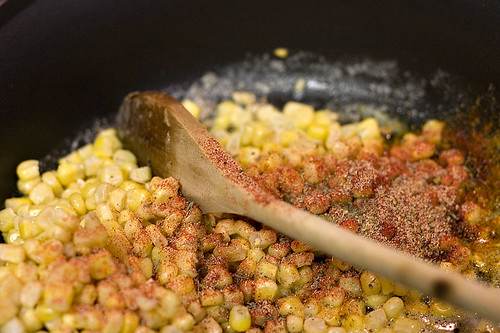
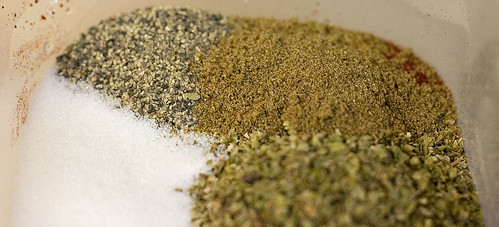
This time I tried something different: I used the Creole Seasoning recipe from the cookbook. In the past, I just used some Zatarain’s Creole Seasoning that I had purchased at some point in time. I suppose it might make me a bad person to use a premixed seasoning but it was easy and it was there.

I figured using a homemade spice blend would clearly be superior to the premixed variety. But I was wrong, sort of. The two different spice blends yield very different results. The Zatarain’s is spicier and saltier. The homemade spice blend has a smoky flavor and has the savory flavor of the herbs. I prefer the homemade spice blend but Angela liked the Zatarain’s. It’s still up in the air which I’ll use in the future. Most likely, I’ll use each at different times depending on what we’re eating it with.

CRW_0730


Cajun Corn
Adapted from Dinosaur Bar-B-Que: An American Roadhouse

4 tbsp butter
1 tbsp minced garlic
3 cups frozen corn, defrosted
5 tsp Creole Seasoning
salt
2 tbsp chopped fresh Italian parsley

  1. Melt the butter in a medium sauce pan over medium heat. When the butter has stopped foaming, add the garlic and sauté until golden, about 3 minutes.
  2. Add the corn to the sauce pan and mix well.
  3. Add the Creole Seasoning and season with salt to taste. Cook over medium heat for about 5 minutes to allow the corn to heat through.
  4. Remove the sauce pan from the heat and stir in the parsley.
  5. Serve immediately.

Serves 4.


Creole Seasoning
Adapted from Dinosaur Bar-B-Que: An American Roadhouse

1/2 cup paprika
1/2 cup powdered garlic
1/4 cup powdered onion
3 tbsp ground black pepper
2 tsp ground white pepper
2 tsp cayenne pepper
1/4 cup dried oregano
1/4 cup dried thyme
2 tsp ground cumin
2 tbsp sugar

  1. Mix together all ingredients and place in a sealable container.

Makes 2 1/2 cups.

Fetuccini with Seared Scallops in a Lemon-Garlic Cream Sauce

CRW_0698

Every week at the farmer’s market, I see the fish vendor. I always stop and look at chalkboard list of products and prices. The line almost always stretches around the back of his truck. My usual thought is that I don’t have enough cash to buy anything and, anyway, Angela doesn’t like fish so it’s not really worth it.

Before we left for the market, Angela had asked if we could have shrimp for dinner. I had some frozen shrimp in the freezer but they wouldn’t easily defrost in time and I don’t particularly relish force defrosting shrimp (although it can be done). So, when I came to the farmer’s market this week, and saw that not only was the fish vendor selling jumbo shrimp but that also his line was relatively short (and I had extra cash), I had to get in line and buy some.

A patron in line ahead of me ordered some scallops. In fact, he thought he was buying all the scallops: he wanted about 12 and that’s how many the vendor thought were left. Instead, the fish vendor had mis-estimated how many were left. So I decided that this week they were also going to be mine.

When I presented my acquisitions to Angela, she decided that the shrimp would wait until the next day and she wanted them seared in a cream sauce. I had never made such a dish but it sounded good to me so I thought I’d give it a try.

CRW_0691

I usually cook from recipes. Occasionally, I’ll try and improvise. Unfortunately, it’s usually a bit disappointing when I do. So I have an aversion to improvisation. Particularly when it comes to expensive ingredients as I don’t want to waste the money.

With this recipe (I wanted to say today but I made this on Sunday), I may have finally broken the streak. To be fair, this isn’t particularly complicated or difficult recipe. But I am pleased with it.

Neither the garlic nor the lemon are overpowering. It didn’t hurt that we had high quality scallops (better than frozen at least). And the sauce went well with the pasta.

Angela would have liked her scallops a bit more seared but it may require a switch to clarified butter to actually make that happen.

The serving range is a bit large as the two of us ate all of the recipe but it could easily be served to four if they aren’t particularly hungry. But it’s good enough for two to eat the entirety.

CRW_0696


Fetuccini with Seared Scallops in a Lemon-Garlic Cream Sauce

1 lbs. large scallops
salt and pepper
3 tbsp butter
2 cloves garlic, diced
1/4 cup dry vermouth or white wine
1 cup heavy cream
juice of 1 lemon
1 tbsp diced Italian parsley
1 lbs. fresh fettuccini, preferably homemade

  1. Remove the small muscle attached to the scallop and discard. Dry the scallops in paper towels thoroughly. Season with salt and pepper on both sides.
  2. Melt the butter in a large skillet over medium-high heat. Once the butter has stopped foaming, add the scallops. Sear the scallops in the butter on both sides, about 3 to 4 minutes per side. Remove the scallops to a plate and cover with aluminum foil.
  3. Reduce heat of the skillet to medium and add the garlic. Sauté the garlic until it is golden, about 1 minute.
  4. Deglaze the skillet with the vermouth or wine. Increase heat to high and boil down the vermouth until it is reduced by half.
  5. Add the heavy cream and bring to a simmer. Simmer the heavy cream until it is thickened. Season the sauce with salt and pepper and add the lemon juice. Reduce heat to medium-low.
  6. Meanwhile, cook the pasta in salted boiling water until it is just undercooked.
  7. Return the scallops to the skillet and add the parsley. Toss the sauce with the scallops until they are well coated.
  8. Remove the pasta from the boiling water and add it to the skillet.
  9. Increase heat to medium-high and cook for 1 minute more.
  10. Serve immediately.

Serves 2-4.

Suprêmes de Volaille aux Champignons (Chicken Breasts with Mushrooms and Cream)

CRW_0659

Ever have a dinner that is surprisingly good? This was one of them. I never have high hopes for anything based around a chicken breast. They’re frequently dry and tasteless. And, while I haven’t tried it, I’m sure that brining helps (yet another thing on my cooking to do list). But, when you get down to it, chicken breasts aren’t particularly exciting. In many ways, they’re the tofu of the meat eating world except they don’t readily take on other flavors as well.

Except, when I made Suprêmes de Volaille aux Champignons (I’ve been avoiding using the proper name as it’s a bit incongruous in a sentence), it was surprisingly good. It wasn’t a burst of flavor in your mouth but it was simple and it was good. The chicken wasn’t dry and had some good flavor but the sauce was very creamy and chickeny. It may not be something to serve to guests but it’s good for a weeknight meal.

CRW_0654

I was particularly fond of the mushrooms (Angela doesn’t like them; and she also complains that I only say she doesn’t like things; she did like the chicken, so there). If you look at the pictures, you’ll think I had only a few but I didn’t ladle the rest of them out of the skillet until after taking the pictures. By the time I was finished, there were more mushrooms than chicken.

I should say, however, if you prepare this recipe realize that I did use a smaller chicken that I got from the farmer’s market. The breasts themselves were pretty small, probably only several ounces each; so the times may be different if you use a larger chicken breast. I’d suggest cooking to temperature instead of time.

I’m a bit surprised by this recipe as it doesn’t involving browning the chicken. Normally, browning meat is important for the development of flavor but not in this recipe. And I can’t say I missed it. Given that the chicken breast is small, a greater proportion of the flavor comes from the sauce and from the chicken stock in the sauce.

Serve with Gratin Dauphinois Madame Cartet (Madame Cartet’s Potato Gratin).

CRW_0656

Suprêmes de Volaille aux Champignons (Chicken Breasts with Mushrooms and Cream)
Adapted from Mastering the Art of French Cooking

2 boneless, skinless chicken breasts
1/2 tsp lemon juice
salt
3 tbsp butter
1 tbsp minced shallots
1/4 lbs. mushrooms, cleaned and quartered
2 tbsp chicken stock
2 tbsp white vermouth
1/2 cup heavy cream
1 tbsp parsley

  1. Preheat the oven to 375ºF.
  2. Rub the chicken breasts with a small amount of the lemon juice and season with salt. Set aside.
  3. In a large skillet, heat the butter over medium heat until it is foaming. Add the shallots and sauté for 1 minute. Add the mushrooms and sauté for 2 minutes more. Season with salt.
  4. Add the chicken breasts to the skillet and roll them in the butter. Cover the skillet and place it in the oven. Cook for about 7 minutes or until the chicken breasts reach an internal temperature of 165ºF.
  5. Remove the skillet from the oven and remove the chicken breasts from the skillet. Add the stock and vermouth to the skillet and bring to a boil over high heat. Boil until the liquid is syrupy.
  6. Add the cream and reduce heat to a simmer. Simmer until the cream is thickened. Remove from the heat.
  7. Season with salt and lemon juice as needed. Stir in the parsley.
  8. Serve the chicken covered with the sauce and mushrooms.

Serves 2.

Tortellini Panna e Prosciutto (Tortellini with Cream and Prosciutto)

CRW_0600


In Italy, this was one of my favorite dishes to order. While I had never been to Italy before and I’m not of Italian decent, this was instantly comfort food, even though it was foreign to me. It didn’t hurt that it almost universally good.

The first time I tried my own hand at tortellini panna e prosciutto the tortellini were my undoing. I decided to be a perfectionist and measure the size of each tortellini. It would’ve helped to keep them all the same size if I could cut straight. It ended up taking an inordinate amount of time: I think it took about 2 hours just to form them.

CRW_0584


I would’ve been hesitant to make them again but they’re really good. I’ve managed to get my tortellini making time to about 1 hour but that’s still a significant investment of time and energy.

This is also probably not particularly good for you. The tortellini are filled with cheese. The sauce is similar to alfredo sauce but with prosciutto added. However, I probably burned enough calories making the tortellini.

CRW_0592


I’ve posted instructions for making pasta before. The tortellini recipe I use is basically the same that I use for cheese ravioli but in a different shape. You could also use fresh fettucini in place of the tortellini if you don’t want to invest as much time. It’s also sometimes served with peas (becoming tortellini panna, prosciutto e piselli) if you’d like it with a green vegetable.

I always try and make enough so that I’ll have left-overs for lunch the next day but for some reason we always manage to eat them all.

CRW_0597


Tortellini Panna e Prosciutto (Tortellini with Cream and Prosciutto)

Tortellini:
1/2 cup ricotta
1/4 cup grated parmesan
2 tbsp diced Italian parsley
3 eggs
salt and pepper
2 cups all purpose flour

Sauce:
4 tbsp butter
4 oz. prosciutto
1/2 cup heavy cream
1/4 cup parmesan

  1. In a bowl, stir together the ricotta, parmesan, and parsley, attempting to break the ricotta into as small pieces as possible. Stir in one egg and season with salt and pepper. Set aside.
  2. Using the well method, mix the flour with the remaining 2 eggs to form a dough. Knead the dough briefly and then divide it into 4 pieces.
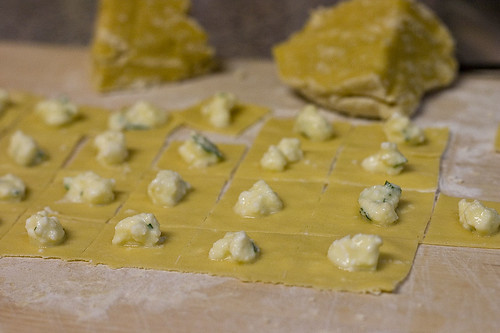
  3. Roll out 1 piece of dough to the thinest setting on a pasta machine. Using a pizza cutter, cut the dough into approximately 1 1/2″ squares. Discard any dough that is not approximately square. On each square, place about 1/4 tsp of the filling made previously. Fold each square in half by having two opposite corners meet, forming a isosceles triangle. Make sure that the dough forms a good seal. Pull the two corners of the triangle which form the longest side together to form the tortellini. Repeat with the remaining dough.
  4. Cook the tortellini in boiling salted water about 3 minutes or 1 minute after it floats.
  5. Melt the butter for the sauce in a large sauce pan over medium heat. When the butter is melted, add the prosciutto and sauté for about 4 minutes.
  6. Add the heavy cream and bring to a simmer and allow the cream to reduce. Stir in the parmesan cheese.
  7. When the pasta is done cooking, add the pasta to the sauce and cook for 1 minute more.
  8. Serve with additional grated parmesan.

Serves 2-3.

Rotkohl (Braised Red Cabbage with Bacon)

CRW_0578


At some level, I’m quite in touch with my German heritage. Cabbage, whether braised or pickled, frequently graced our table while I was growing up.

As winter approaches and the farmer’s market thins out, I become drawn to the vegetables that are still available. Even in southern California we have seasonality with our produce (despite the fact that tomatoes are still available).

Angela dislikes cabbage and so it takes several weeks before I’m willing to indulge myself. It’s hard to make just a little bit of cabbage and it takes time to properly cook it. I also need to prepare myself for it.

My particular preference is for the red varieties. To me, they have a deeper flavor. I specifically remember having some outstanding braised red cabbage in Germany (as well as excellent sauerkraut); I barely remember any sausage or pork roast that I ate. That may give you some idea of my appreciation of good cabbage.

I bought this copy of Saveur in the airport to read on our flight to Florida for Christmas (and then our unexpected “vacation” in Milwaukee). While looking through it, I happened upon this recipe for braised red cabbage. And, then and there, I knew I’d have to make it for myself.

So what that it serves 6 to 8? I apparently will have to eat leftover cabbage for the next week (I found out today that it works pretty well stuffed into a pita with leftover pork and reheated). Sometimes dealing with the leftovers is worth the initial splurge.

CRW_0577


Rotkohl (Braised Red Cabbage with Bacon)
adapted from Saveur, December 2007

1 tbsp vegetable oil
6 slices of bacon, cut into lardons
1 tbsp sugar
1 yellow onion, diced
salt and pepper
1 Granny Smith apple, peeled, cored, and roughly choped
1/3 cup port
1/4 cup red wine vinegar
1 large head of red cabbage, cored and finely shredded
1 cup chicken stock
1 cup beef stock
1/4 cup red currant jelly

  1. Heat the vegetable oil in a large dutch oven over medium-high heat until hot. Add the bacon and cook until crisp, about 5 minutes.
  2. Add the sugar and cook for 30 seconds, stirring occasionally.
  3. Add the onions to the dutch oven and season with salt and pepper. Cook until the onions are soft, about 10 minutes.
  4. Stir in the apples, cover, and reduce heat to medium-low. Cook until the apples are soft, about 8 minutes.
  5. Add the port, vinegar, and cabbage to the dutch oven. Stir to combine. Cover and cook until the cabbage is slightly wilted, about 7 minutes.
  6. Add the chicken and beef stock and season with salt and pepper. Increase heat to high to bring to a simmer. Cover, and decrease heat to medium-low. Simmer for 1 1/4 hours until the cabbage is tender.
  7. Uncover and stir in the red current jelly. Season with salt and pepper and cook for4 to 5 minutes more.
  8. Serve with roast pork.

Serves 6 to 8.

Djaj Bil Assal (Chicken with Caramelized Baby Onions and Honey)

CRW_0541


To a certain extent, this is penance. For some reason, it never clicked that Moroccan-Style Pork Tenderloin couldn’t be Moroccan because of the pork. I was just looking for a new way to cook pork tenderloin.

But it made me wonder what Moroccan food was. Middle Eastern cuisine isn’t something that I’m intimately familiar with. The closest I’ve come is one of several Lebanese restaurants in the area. What I’ve had I’ve liked but Lebanon isn’t that geographically close to Morocco.

So my only connection to Moroccan food is through cookbooks and thankfully I’ve moved on from the one that directed me to Moroccan-styled Pork Tenderloin. I chose Chicken with Caramelized Baby Onions and Honey because we had chicken on-hand and it seemed suitably exotic as well as not terribly difficult.

All of which were true. Chicken with cinnamon is an unusual flavor combination to my western taste buds. It’s not bad by far. It’s just different. I actually liked it even if I wouldn’t want to eat it every day. They honey added a pleasant sweetness without being overpowering. It also managed to caramelize significantly.

I did make a slight mistake when I made it. I originally missed the addition of the onions right after the white chicken meat is removed. I realized it about 10 minutes later when I went to turn the chicken. The onions were fully cooked but they didn’t manage to caramelize quite as much as was indicated in the original recipe. I didn’t notice that much of a difference but it may be even better with properly caramelized onions (hence the title).

CRW_0540


Djaj Bil Assal (Chicken with Caramelized Baby Onions and Honey)
Adapted from Arabesque

1 lbs. pearl onions
1 onion, diced
4 tbsp vegetable oil
pinch of saffron threads
1 tsp ground ginger
1 tsp ground cinnamon
1 chicken, cut into pieces
salt and pepper
1 tbsp honey

  1. Blanch the pearl onions in boiling water for 5 minutes. Drain. Once the onions are cool, peel them and cut off the root end.
  2. Dry the chicken with paper towels on all sides. Season with salt and pepper.
  3. Sauté the diced onion in a large skillet over medium-high heat.
  4. Stir in the saffron, ginger, and cinnamon.
  5. Brown the chicken on both sides in the skillet, in batches if necessary. Return all the chicken to the skillet.
  6. Add 1 cup water and bring to a simmer. Cover and simmer for 15 minutes, turning the chicken once. Remove the white meat pieces of chicken to a side dish and add the peeled pearl onions. Cover again and simmer for 25 minutes, turning the chicken onces.
  7. Remove the chicken to a side dish. Stir the honey into the pan. Cook, uncovered, over medium-high heat until the water has evaporated and the pearl onions have caramelized.
  8. Return the chicken to the skillet and simmer until the chicken is warmed through.
  9. Serve the chicken topped with the pearl onions and the sauce.

Serves 4.

Tartlette aux Framboise (Raspberry Tart)

CRW_0531


Growing up, my parents had a raspberry bush in the back yard. I used to love going down to eat them right off the bush. I even picked them and sold them in a mini-road side farm stand. It was all on the honor system and no one took advantage of me. Someone did eventually steal the Fisher Price picnic table that I used for displaying the produce but they may have assumed it was sitting out for the trash. Unfortunately, the raspberry bush is no longer there (it reached it’s fruit producing lifespan and my parents opted to not replace it) but my love of raspberries is.

On my first visit to France, there was a small bakery across the street from our hotel. The first couple days I partook of the hotel’s continental breakfast but was not particularly impressed. I went to the bakery for breakfast instead and settled on the raspberry tart. My French is practically non-existent but by a combination of half remembering framboise and pointing I was able to get what I wanted.

It may be the haziness of memory, but it was good. Really good. I did a little more traveling in France and couldn’t find anything similar. I’ve looked elsewhere and never found something quite as good. I found a raspberry tart in San Francisco but it used a lemon curd base which wasn’t what I was looking for.

CRW_0526


A while ago, I had decided that I would make myself a raspberry tart. I may not be a pastry chef (I don’t have the patience for that) but what better way to make something that you like? Aside from inertia, the main reason I had never attempted to make one before was simply that raspberries were expensive and I didn’t want to waste them by making a bad tart.

The other day, I was walking by Farm Boy and noticed they were advertising a half-pint of raspberries for $1.00. That was too good of a deal to pass up (regardless of the unknown provenance of the raspberries).

I really haven’t made any tarts before so it was an issue of figuring exactly what to use in making it. A tart consists of the tart shell, the cream used in the shell, and then the topping. I settled on pâte sablée and creme pâstissière because they seemed closest to what I’d had in the past and they both seemed fairly simple and classic. I’m not entirely sure it was the right choice.

The tart was good. Quite good. But the creme pâstissière seemed to overpower the raspberries a bit. The pâte sablée also didn’t have great structural integrity so the creme pâstissière started spilling out and making a mess. I ended up having to eat it with a fork.

This recipe may need a bit more work but it’s still good. It isn’t overly sweet. It would make a good afternoon snack.

CRW_0527


Tartlette aux Framboise (Raspberry Tart)

Pâte Sablée
Crème Pâstissière
1 cup raspberries

  1. Pat the dough into 3 four inch mini tart pans. Refrigerate the dough for 30 minutes.
  2. Preheat the oven to 425°F.
  3. Place a layer of aluminum foil over the tart pans. Place pastry weights on top of the aluminum foil.
  4. Place the tart pans on a baking tray and bake in the middle of the preheated oven for 20 minutes.
  5. Remove the tart pans from the oven, remove the pastry weights and aluminum foil, and return to the oven. Bake for 7 more minutes.
  6. Remove the tart pans from the oven and allow to cool completely. Remove the tart dough from the tart pan.
  7. Rinse and dry the raspberries.
  8. Place a layer of crème pâstissière in each tart. Cover with the raspberries.
  9. Chill completely and serve.

Makes 3 mini-tarts.


Pâte Sablée (Shortbread Dough)
Adapted from The Roux Brothers on Patisserie

250 g flour
200 g cold butter (about 7 tbsp), diced
100 g powdered sugar
pinch of salt
2 egg yolks

  1. Sift the flour onto a work surface and make a well in the center.
  2. Place the butter in the well and work with your fingers until it is very soft.
  3. Add the powdered sugar and the salt to the butter and cream them together with your fingers.
  4. Add the egg yolk to the well and mix well.
  5. Slowly incorporate the flour into the butter mixture. Mix until it is just homogeneous.


Crème Pâstissière (Pastry Cream)
Adapted from The Roux Brothers on Patisserie

6 egg yolks
125 g sugar
40 g flour
500 ml milk
1/2 tsp vanilla extract

  1. Place the egg yolks and 1/3 of the sugar in a bowl. Whisk together until pale ribbons are formed. Whisk in the flour.
  2. In a sauce pan, combine the flour, remaining sugar, and vanilla extract. Heat over high heat.
  3. When the mixture begins to bubble, remove from the heat. Temper 1/3 of the milk mixture into the bowl with the eggs, stirring constantly. Pour the milk and the eggs back into the sauce pan, stirring constantly.
  4. Heat over medium low heat, stirring constantly, until the mixture thickens.
  5. Remove from the heat and allow to cool completely.

Turkey Potpie with Cheddar Biscuit Crust

CRW_0522

If you’re anything like me, you still have leftover turkey from Thanksgiving in the freezer. And, if you’re not, you can just use leftover turkey from Christmas.

I originally saw this recipe before Thanksgiving and made a mental reminder that we could eat something besides Turkey quesadillas in the days after Thanksgiving. Unfortunately, we immediately went out of town and then I had to travel for business so the turkey got relegated to the freezer.

And there it sat until after Christmas. At that point, the freezer was getting a bit full (but isn’t it always?) and I felt the need to clean some items out of it. The turkey was the first item to get my attention.

This is a pretty easy recipe even though it involves several different parts. It even makes stock making easy. There’s no skimming. There’s no browning. There’s no aromatics in the stock. Just cover with water and simmer for about an hour. It’s also one of the most flavorful stocks I’ve ever tasted. Just don’t be like me and forget about the excess stock and leave it out overnight, rendering it only fit for disposal.

As I was making the potpie, Angela thought she was going to hate it (for reasons unknown to me). In the end, she liked it quite a bit. Even enough to take the leftovers for lunch today (that’s a surprise even to me).

If you have leftover turkey, this is the recipe to use it.

CRW_0502


Turkey Potpie with Cheddar Biscuit Crust
Adapted from Gourmet, November 2007

For Stock:
4 cups turkey bones and skin
water
CRW_0516
For Filling:
1 medium onion, diced
2 large peeled carrots, cut into 1/2″ pieces
2 celery stalks, cut into 1/2″ pieces
1 large peeled parsnip, cut into 1/2″ pieces
1 tsp chopped thyme
3 tbsp butter
1/2 lbs. mushrooms, cleaned and quartered
1/4 cup all purpose flour
4 cups cooked turkey meat
10 oz. frozen peas, defrosted

For Crust:
2 cups all purpose flour
2 tsp baking powder
1 tsp baking soda
1/2 tsp salt
1/2 tsp black pepper
1 cup grated cheddar cheese
1/4 cup grated parmesan cheese
6 tbsp butter, cut into tbsps
1 1/4 cup buttermilk

  1. Place the turkey bones and skin in a large stock pot and cover with water. Bring to a simmer and simmer slowly until the stock is flavorful about 1 hour.
  2. Drain the stock through a strainer and reserve 3 1/2 cups for the potpie. Store the remainder for another use.
  3. In a large skillet, melt the butter over medium heat. When the butter is melted, add the onion, carrots, celery, parsnip, and thyme. Cover and sweat the ingredients until they are almost soft, 12 to 15 minutes.
  4. Uncover the skillet and add the mushrooms. Sweat until the mushrooms are tender, 5 to 7 minutes.
  5. Sprinkle the flour over the vegetables and stir until mixed well. Cook over medium heat, stirring constantly, for 2 minutes.
  6. Deglaze the skillet with the reserved turkey stock (3 1/2 cups) and bring to a boil. Boil, stirring regularly, until the sauce is thickened, about 5 minutes.
  7. Stir in the turkey meat and peas. Taste for seasoning of salt and pepper.
  8. Preheat the oven to 400ºF.
  9. Sift together the flour, baking powder, baking soda, salt, and pepper. Add the cheese and mix well.
  10. Using a pastry blender (or two knives), blend in the butter until the mixture is coarse.
  11. Add the buttermilk and stir until just mixed.
  12. Spread the biscuit topping over the turkey mixture evenly.
  13. Bake in the preheated oven until the topping is browned, 35 to 40 minutes.
  14. Let stand 5 minutes before serving.

Serves 8.

Zuni Café House-Cured Pork Tenderloin

CRW_0444


I was trying to write a witty and informative story about this dish when I realized that we had actually eaten it over two weeks ago (that’s what we get for going away for the holidays). The main thing that I do remember is that it was good. Really really good.

I’ve begun wondering what pork really tastes like. I’ve suffered through enough bad pork chops to know that it can taste like chewing. And I think I’ve figured out how to make pork taste like something else. Many of the pork dishes I’ve cooked have been quite tasty but they don’t really make me think of pork. I have noticed that the pork flavor in home-cured meats like bacon and pancetta has a more pork flavor to it but I’ve never really achieved that in other pork dishes.

CRW_0389


Until I made this one. I’ve brined pork before and it made it tender and even added flavor with it, but I never was able to make the pork taste porkier. I don’t know what it is about this brine that makes the pork flavor so much more pronounced. My guess is that it’s the length of the brine combined with a weaker brine solution.

This is a fantastically easy recipe. The hardest part is remembering to brine the pork several days in advance. Cooking the pork couldn’t be easier: just sear and then roast in the oven.

It’s not a particularly sexy presentation and it doesn’t use particularly exotic ingredients. It’s just the application of simple ingredients to make a wonderful meal.

CRW_0440


Zuni Café House-Cured Pork Tenderloin
Adapted from The Zuni Cafe Cookbook

1 pork tenderloin, about 1 lbs.
2 bay leaves, crumbled
2 dried chiles
4 crushed juniper berries
2 1/2 cups water
3 tbsp sugar
2 tbsp kosher salt

  1. Place 1 cup of water and the bay leaves, dried chiles, and juniper berries in a sauce pan. Bring the water to a simmer over high heat. Stir and break up the ingredients with a wooden spoon. Remove from the heat and cover. Allow to infuse for 10 minutes.
  2. Add the remaining water, the sugar, and salt to the aromatic mixture. Stir until the salt and sugar are dissolved. Put the pork tenderloin in a large zip-top bag and pour the brine over it. Place in the refrigerator and allow to brine for 2 to 4 days.
  3. Remove the pork tenderloin from the refrigerator 1 hour before cooking. Remove from the brine and pat dry. Rub the pork tenderloin with olive oil.
  4. Preheat the oven to 425ºF.
  5. Place a heavy cast-iron skillet over high-heat. When hot, sear the tenderloin on all three sides. Turn the tenderloin to the fourth side and place the skillet in the oven.
  6. Cook the tenderloin in the oven until it reaches an internal temperature of 140ºF. Remove the tenderloin from the oven and then remove it from the cast-iron skillet. Wrap the tenderloin in aluminum foil and allow it to rest for 5 to 10 minutes.
  7. Slice the tenderloin into thick slices and serve.

Serves 2 to 3.