Posts Tagged 'Recipe'


Fried Chicken

CRW_9635

Every once in awhile I get a craving for fried chicken. And the sad thing is, until yesterday, I’ve been unable to make it and there’s a dearth of good fried chicken here (I have still yet to try Roscoe’s Chicken and Waffles). I’ve tried a number of recipes (including Cook’s Illustrated among others) and none of them satisfied (usually the batter didn’t come out correctly).

I mean, fried chicken has a look. Everyone knows what fried chicken looks like. And mine never did. It was either too pale or too dark. Or it had mostly fallen off the chicken. And it didn’t have a satisfactory taste to it.

CRW_9633

But that all changed last night. I finally had fried chicken success. I was finally a fried chicken master. The chicken was browned. It had the look. It was juicy all the way through (is it me or is one of the most disappointing things in the world dry fried chicken breasts?) Okay, it came out overly salty (I’m blaming that on my over optimistic reading of the line “brine for at least 4 hours or overnight”; when they say overnight, the Lee Brother’s apparently don’t mean 24 hours). But it was still good. Very good. And it was even better with their biscuits and creamed corn.

CRW_9637

Fried Chicken
Adapted from The Lee Bros. Southern Cookbook: Stories and Recipes for Southerners and Would-be Southerners

3 chicken thighs, bone-in and skin-on
3 chicken legs, bone-in and skin-on
3 cups peanut or canola oil

Brine:
2 cups water
1/4 cup kosher salt

Dredging Mixture:
1/2 cup all purpose flour
3 tbsp cornmeal
2 tsp kosher salt
1 1/2 tsp black pepper

  1. In a medium bowl (one that holds about 2 to 3 quarts; mine is actually my “small” bowl), stir together the brine ingredients until the salt is dissolved. Trim any excess fat from the chicken thighs and legs (on mine, there was a large layer of fat on the underside of the chicken thighs) and then add them to the brine. Cover the bowl and place in the refrigerator. Brine for 4 hours and up to overnight (which is what the recipe said; I brined over night and the chicken was too salty; in this case, overnight should mean no more than 8 hours or so). Remove the chicken from the refrigerator at least two hours before cooking so that it can come up to room temperature.
  2. In shallow dish mix the dredging mixture together (I actually have a set of plastic dishes that are designed for breading food). Dredge each piece of chicken through the dredging mixture, until coated thoroughly. Shake off any excess.
  3. In a large skillet (preferably cast iron and you need it to hold all the chicken), add enough oil to coat the bottom by 1/3″. Heat the oil over high heat until it reaches 325ºF. Add the chicken skin side up, cover the pan, and cook for 6 minutes. Turn the chicken, cover the pan, and cook for another 6 minutes. During the cooking process attempt to maintain the heat between 325ºF and 350ºF.
  4. Remove the chicken to a paper towel covered plate.

Serves 2 to 3 (we had leftovers which are my lunch today).

Madeleines

CRW_9610

I have no idea where my love of madeleines developed from. At some point in the past year, I knew that I liked them but I don’t know when I had had them. I do know that the ones usually available in the US are expensive (seriously, Trader Joe’s sells them for about $1 per cookie) and not particularly good.

This summer, I had decided that at some point in the indefinite future I was going to get madeleine pans. Whenever we’d go into a store that would sell esoteric kitchen supplies, I’d look for them and determine that I really didn’t want to buy a single use pan (Alton Brown would be upset with me now) for $12 (realizing that I’d probably need at least two to make them effectively).

CRW_9598

When my in-laws came to visit, we tend to end up at shopping locations more frequently. As I was still on my quest, I continued to look for them and mentioned to my in-laws. About a week after they had left, a package arrived in the mail for Angela and I and, lo and behold, there were two non-stick madeleine pans inside. Apparently, my mother-in-law had decided that she needed to go out and buy them for me right away. Her decision was my gain.

This isn’t the first time I’ve made madeleines but the first time I’ve used this recipe. This recipes seems to produce a better texture but the other recipe (from Susan Herrmann Loomis) seemed to make one with better flavor. I think I may combine the two at a later date. Either way, madeleines are always good.

CRW_9600

Madeleines
Adapted from Baking: From My Home to Yours

1 1/3 cup all purpose flour
1 1/2 tsp baking powder
pinch of salt
1 cup sugar
grated zest of 2 lemons
4 large eggs, at room temperature
4 tsp vanilla extract
12 tbsp melted butter, cooled

  1. Place madeleine pans in the refrigerator.
  2. Mix together the flour, salt, and baking powder in a bowl.
  3. In a mixer’s bowl, mix together the sugar and lemon zest with your finger.
  4. Add the eggs and, using the whisk attachment, mix at medium speed for 2 to 3 minutes. Add the vanilla extract and mix to combine.
  5. Fold in the flour followed by the melted butter.
  6. Remove the madeleine pans from the refrigerator and grease them. Place batter into pans, about 1 tbsp per madeleine.
  7. Refrigerate the pans and any remaining batter for at least 1 hour.
  8. Preheat the oven to 400°F.
  9. Bake the madeleines for 11 to 13 minutes. There’s no need to refrigerate any remaining batter before cooking.

Makes 24 madeleines.

Blanquette de Veau à L’Ancienne (White veal stew)

Look at how off-white my white sauce is

The name of this dish really stretches the limits of my French ability (which isn’t saying much as I don’t speak French). I did try an online dictionary to translate blanquette which apparently is translated as blanquette in English (I know English is a strange language but I never really though blanquette was part of it; Firefox’s spellcheck hasn’t heard of it). Anyway, it’s basically a white stew.

The genesis of this dish (well, for me making it) stems from my love of veal. As a note to farmers, please confine cute baby cows to tiny cages in order that they may be slaughtered and I may feast on their succulent flesh. I have no qualms about the condition of the animals as long as they’re still tasty. Which is not entirely true but makes for good copy.

So, several months ago (at this point, “several months ago” can be construed as a bad sign) I was grocery shopping and happened to notice that there was veal blade steak for sale (not a cut of veal that the grocery store regularly sells; speaking of which, why is there such poor selection of veal and lamb at the average grocery store? I’ve never seen a veal roast of any type anywhere). Not only was it for sale, it was also no sale. So I grabbed the promised deliciousness, after all there was something I could make with it. Once it arrived home, it was put into refrigerator. And it waited. And waited. Until I realized that it was liable to go bad if I left it in there any longer. So, up to the freezer it went. And it waited. And waited. And waited. Realize that several months have passed at this point and it looks like it’s accumulating a significant amount of freezer burn (good thing I didn’t take any pictures of that or I’d be the laughing stock of the food blog world for weeks; or maybe not, there’s at least one advantage to not being popular). And of course I’ve realized by this point that I have no idea what to do with it. It’s shoulder meat which isn’t particularly tender but it’s sold as a steak which would imply that you should pan fry it and cook it quickly but the shoulder part says it should be braised. What to do? As you may assume, I decided to just let it relax in the freezer for awhile (it was kept comfortable by various chicken pieces, some pork chops, several pieces of pork butt, and some veal scallopini).

The potatoes turned out much more photogenic than I ever imagined

About a week ago, I decided that it was time to use up all that meat that have been lounging in the freezer for who knew how long (which resulted in the General Tso’s Chicken and the Chicken Pot Pie; I actually have some freezer room available now). On Friday I decided it was time to play my trump card and actually cook (and hopefully eat; it wouldn’t be the first time a meal I’ve made has been inedible) the veal.

Now, I’ve heard reference to blanquette de veau several times. I know it’s mentioned by Anthony Bourdain in at least one of his books (uh, the one full of short stories) and I know there’s a recipe for it in Les Halles Cookbook (oddly, Amazon is charging more for the paperback version than the hardback version). Of course, being a French classic dish means that it’s almost never served in a restaurant anymore (I think the only places that serve classic French are cruise ships and it’s a bit too exotic, or possibly expensive, for a cruise ship). I had no real clue as to what it was or what it tasted like but I figured it couldn’t be that bad. And when had Julia Child led me wrong?

From what I’ve read (it sounds like I’ve extensively researched this dish; I have not; I’ve just heard reference to it), it’s supposed to be in a white sauce. And it’s supposed to be pretty much completely white. Go look at the pictures I posted and determine if the sauce is white. Sure, it’s not brown by any means but it’s also not the whitest sauce ever (you should’ve seen it before the addition of the cream). And really, I’m okay with that. It all results from the fact that I make much more of a brown chicken stock than a white one. This is the first time I’ve had a recipe that really wanted a white stock and even then, I can’t imagine making it. You mean you want me to generate less flavor by not browning the meat and then you want me to make some Rube Goldberg-esque contraption involving a raft of egg whites? Just so the stock isn’t dark? I’m sure that will fly in a classical French brigade kitchen but I’ve got better things to do with my time than that. There’s, uh, Scrubs reruns to watch. That’s the ticket. So I just used the brown chicken stock I had in my freezer (I really don’t think the taste would’ve changed much).

Isn't is sad that such beautiful vegetables get thrown away?

So what’s my opinion of the dish? It’s, uh, different. I’m not used to eating boiled meats and the texture was different (it reminded me of corned beef which is usually boiled). The flavor of the sauce was quite good. The veal probably could of used being salted before being cooked; it seemed like it was missing some salt (there’s no instruction to salt the meat before cooking; is there a reason you wouldn’t want to do that with a dish like this?). Also, the original recipe includes an addition of parsley at the end. The green of the parsley just looked odd and the taste didn’t really mesh with the rest of the dish. I would vote for omitting it. If you want an adventure, go ahead and try it. It’s not as hard or complicated as it looks and you might just like it.

Blanquette de Veau à L’Ancienne
Adapted from Mastering the Art of French Cooking


1 lbs. veal stew meat cut into 1″x1″ pieces (I used veal shoulder blade steak)
2 to 3 cups chicken stock
1/2 an onion studded with 1 clove
1 half of a large carrot, peeled and cut into several pieces
a bouquet garni consisting of 1 stalk of celery, 4 parsley stems (with leaves removed), 1/2 bay leaf, and 2 thyme sprigs
salt
9 small white onions
1 1/2 tbsp butter
1 tbsp butter
9 mushrooms
3 tbsp heavy cream
1 egg yolk

  1. In a dutch oven, place the veal and cover with water by 2 inches (you may want to season the veal with salt before this step). Simmer for 10 minutes. Pour the water and veal through a strainer. Rinse off the veal and clean out the dutch oven.
  2. Return the veal to the dutch oven and add the chicken stock to cover the veal by 1/2 inch. Bring the veal to a simmer. Skim any remaining scum from the surface. Once the scum has subsided, add the onion, carrot, and bouquet garni. Season the sauce lightly with salt. Cover with the lid slightly ajar and cook the veal at a simmer for 1 hour to 1 hour and 15 minutes.
  3. While the veal is cooking, cook the onions: Peel the onions and cut a cross in the root end. Place the onions, a 1/4 cup of the stock from the cooking veal, 1/2 tbsp of butter, and a pinch of salt in a sauce pan. Cover and lightly simmer for 50 minutes.
  4. When the veal is finished cooking, pour the contents through a strainer into a bowl. Return the veal to the dutch oven and discard the vegetables. In a sauce pan, over medium heat, melt 1 tbsp of butter and then whisk in 1 tbsp of flour. Cook for 1 minute. Off heat, whisk in the stock from the veal and any remaining liquid from the onions once they have finished. Simmer the mixture for 10 minutes.
  5. Sprinkle the mushrooms with a few drops of lemon juice. Add the mushrooms to the sauce mixture and simmer for another 10 minutes. Check the seasoning of the sauce.
  6. Pour the sauce into the dutch oven with the veal. Add 1 tbsp of cream. Place the dutch oven over medium heat.
  7. In a small bowl, combine the egg yolk with 2 tbsp of cream. Whisk in 1/4 cup of the hot sauce from the dutch oven then add the mixture back into the dutch oven.
  8. Simmer the mixture for a few minutes to warm the contents.

Serves 2.

Cheese Soufflé

Cheese Souffle

Last night, I was all prepared to make Chicken Cordon Bleu. Because it takes a bit of time, I started by grating the cheese. I then went to get the chicken out of the fridge and realized that it had gone bad. Into the trash that went. So the million dollar question at that point was what to do with about a cup of grated Swiss cheese (well, really Jarlsberg but close enough).

To complicate matters, the Von’s near to our apartment had a grand reopening sale (as far as I can tell all that changed is they put a wood floor under the produce section and now carry a larger amount of alcohol) and had 18 eggs foisted on us for free by the checkout clerk (he actually had them send someone to go back and get us our free eggs). Unfortunately, we didn’t win the Ipod Shuffle like the gentleman ahead of us (when told he had won it, his response was “what is that?”). This meant that we had somewhere in the neighborhood of 30 eggs in the refrigerator. This partially spurred the Cinnamon Pound Cake the day before.

Our initial thoughts drifted towards some sort of scrambled eggs and I started looking through some cookbooks for ideas. In my America’s Test Kitchen Family Cookbook (it was cheap at Costco and isn’t a bad cookbook, despite the name) and I saw a recipe for cheese soufflé.

While I’ve had (and made) dessert soufflés, I’ve never actually had a savory soufflé. I’ve never seen one on a restaurant menu (including when I was in France several years ago). They seem delightfully old fashioned (to me at least).

While I’m sure America’s Test Kitchen has a good recipe for a cheese soufflé (why do I consistently want to capitalize soufflé?), when it comes to classic French recipes (and particularly when making them for the first time), I stick with Julia Child and Mastering the Art of French Cooking, Volume One.

The soufflé was quite tasty and significantly more filling than the lightness suggested by a soufflé would imply. Mine, however, did not rise nearly as much as was promised in the recipe. Either my soufflé mold (yes, I have one; it was on clearance at T.J. Maxx and was a good price, despite it being Emeril branded; you can only tell if you look at the bottom) is larger than 6 cups (I didn’t measure it but it looks like it might be) or it could be the fact that when I finished the soufflé batter, the oven had preheated all the way so it had to sit out longer. I would also probably add some cream of tartar to the egg whites to help stabilize them (it was recommended in the introduction to soufflés if you aren’t beating them in a copper bowl but I forgot about it). The soufflé almost completely collapsed once we started serving it (you’re guess is as good as mine as to how to do it; Julia Child’s instructions were a bit lacking on serving).

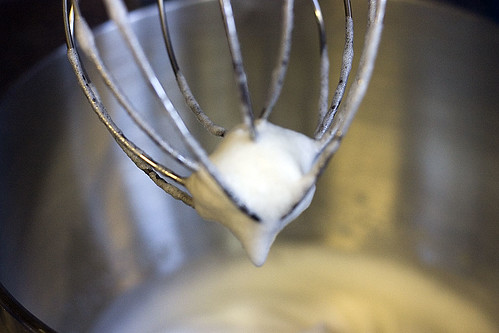
Beaten Egg Whites

Cheese Soufflé
Adapted from Mastering the Art of French Cooking, Volume One

3 tbsp butter
3 tbsp flour
1 cup boiling milk
1/2 tsp salt
1/8 tsp pepper
a pinch of cayenne pepper
a pinch of nutmeg
4 egg yolks
5 egg whites
3/4 cup grated Swiss cheese

  1. Preheat oven to 400°F.
  2. Butter a 6 cup soufflé mold (or something similar in shape and size) and sprinkle with 1 tbsp of cheese.
  3. Melt the butter in a sauce pan over medium-high heat. Whisk in the flour and cook for two minutes.
  4. Remove the sauce pan from heat and whisk in the boiling milk. Add the salt, pepper, cayenne pepper, and grated nutmeg.
  5. Over medium-high heat, cook the mixture until thickened (about a minute).
  6. Off heat, whisk the egg yolks into the mixture.
  7. Beat the egg whites until stiff with a pinch of salt. A pinch of cream of tartar will probably allow your soufflé to rise and stay risen better than mine.
  8. Add 1/4 of the egg whites into the sauce pan mixture and mix well. Add all but 1 tbsp of the cheese into the mixture and mix well.
  9. Fold in the remaining egg whites into the mixture.
  10. Carefully pour the soufflé mixture into the prepared soufflé mold. Level the top and sprinkle with cheese.
  11. Put the soufflé in the oven and immediately drop the temperature to 375°F. Bake for 30 to 35 minutes or until the top is well browned and a skewer inserted into the center comes out cleanly.

Serves 2.

General Tso’s Chicken or How to Create Pepper Spray in Your Own Kitchen

Apparently, if you cook chilies in more oil than necessary, then add liquid, you will create your very own homemade pepper spray. As I was cooking the General Tso’s Chicken, I was suddenly overcome by a combination hacking and sneezing fit (in retrospect it’s not something that I thought would be physiologically possible but I often manage to surprise myself with my own abilities). By the time my wife noticed my predicament, the toxic cloud had drifted the few feet to her and she was overcome. And now I understand how pepper spray works.

Now, I don’t normally cook Chinese food (let alone any Asian cuisine). It’s not that I don’t like it, it’s just that it’s culinarily 180 degrees from my comfort zone. I usually stick to Italian or French dishes, occasionally adding in other European fare or the Americanized versions thereof (thereof is a seriously underrated word in the English language). In my mind, Asian food is something you go out to eat (speaking of which, why are there a dearth of reasonably good Chinese places in Long Beach?)

Chinese and other Asian foods are different from my American (and by extension European) culinary tradition (well don’t I sound pompous; perhaps I should refer to food tradition). The techniques are just significantly different. While thinking about the differences, I realized I’m not even qualified to comment on what the differences are: that is my level of understanding of Asian cuisine. I’ve made a few successful stir fries (and I highly recommend this tutorial) but they were rather Americanized affairs.

Despite this lack of knowledge, I had heard rumors that Revolutionary Chinese Cookbook: Recipes from Hunan Province was a good cookbook. I also have happened to find that the library has an online request system (somehow with regards to libraries I’m stuck in mid-1980’s; I’m still skeptical of using anything that isn’t a real card catalog). Of course the combination of a cookbook to reconnoiter and an automagical book request system meant that I got a copy of the book into my grubby little hands (their much grubbier when I make bread but that’s another story, or would that be blog post?).

Being a good American, I immediately thought that many of the recipes would not be the first on my list to try. I mean, many of them even had vegetables in them. While that’s not really what I thought, I did think that some of the ingredients I had not heard of before and would be a bit harder to come by and that my vegetable-hating wife (well, maybe not all vegetables) would not like them.

So what was probably one of the only recipes in the entire cookbook I had heard of (not counting the spring rolls; is it just me or do spring rolls seem to be entirely too time consuming to actually make? all those who make them have my respect) was General Tso’s Chicken. In the cookbook, two different versions are listed: one from Taiwan (where the dish was invented) and one from Hunan (which is the style in which it is made). Not surprising to me was the fact that it’s virtual unheard of in China (that would be the People’s Republic of, it’s actually found in Taiwan). Contrary to rumors I heard, however, there was actually a General Tso at some point in the past (and I figured he was just made up).

As to the recipe itself, the first item to note is that it is spicy. Very spicy. Now, I can’t claim to like my food flaming hot, but I do like my food a bit spicy. This was a bit spicier than I’d like and my wife gave up eating it after awhile due to its heat. So if you don’t like it hot, add less chilies. In retrospect, seasoning the chicken with salt and pepper before mixing in the marinade would make a better dish (to my Anglo-Saxon mind). The original recipe specified potato flour but it’s not in my pantry, so I substituted corn starch and there didn’t seem to be any ill-effects from it. The recipe also specified Shaioking vinegar which, according to the book, is a dark rice wine vinegar, so I substituted that (which is still a pain to find; I eventually had to go to Little Saigon to find it). My final substitution was replacing peanut oil with canola oil because Costco stopped selling it. While Changsha version is supposed to be closer to American versions of General Tso’s Chicken, it’s really not. There’s a vague resemblance but it’s really a different dish.

General Tso’s Chicken (Changsha Version)
Adapted from Revolutionary Chinese Cookbook: Recipes from Hunan Province

12 oz. chicken (preferably thigh or leg meat)
6 small dried chilies, cut into 3/4″ lengths, seeds removed
3/4 in of fresh ginger, thinly sliced
1 tbsp tomato paste
3 scallions, green parts only, thinly slice
1 tsp sesame oil peanut oil

For the marinade:
2 tsp light soy sauce
1/2 tsp dark soy sauce
1 egg yolk
4 tsp corn starch

For the sauce:
1/2 tsp corn starch
2 tsp sugar
2 tsp black rice vinegar
1/4 tsp dark soy sauce

  1. Cut the chicken into bit-sized pieces. Don’t be like me. Make them actually bite-sized. There’s few things more annoying (this would the textbook definition of hyperbole) than eating food with chopsticks that are too big for one bite.
  2. In a bowl, mix the marinade soy sauce, egg yolk, and chicken. Then mix in the corn starch. The mixture will become very sticky.
  3. In a small bowl, mix the sauce ingredients.
  4. Combine the tomato paste with 1 tbsp of water.
  5. In a wok, add enough oil to come up about 3 to 4 inches (depending on the size of your chicken). Heat oil to between 350° F to 400° F. Deep fry chicken pieces, in several batches, until it is golden brown. Remove chicken to a bowl after deep frying.
  6. Pour all but1 tbsp of oil into a heat proof container. Turn your vent fan onto maximum (you’re about to pepper spray yourself). Turn burner to high. Working quickly, add the dried chilies, then add the garlic, then add the tomato paste. Cook until tomato paste becomes burnt orange. Add the sauce mixture and stand back (this is the pepper spray creation moment). Once the sauce stops boiling with the oil, stir as the sauce thickens.
  7. Once the sauce thickens satisfactorily (you want it relatively thick), add the chicken to the mixture and coat thoroughly.
  8. Off heat, add the scallions and sesame oil.

Serves 2.