Archive Page 4

Moving to Northern Virginia

I have been quite remiss in maintaining this blog over the past month. It’s been almost a month since there was a post. My apologies for that. But I have an excuse.

Next week, we’re moving to northern Virginia. Specifically, I took a job in Springfield, VA. One of the primary motives for this move is to be closer to family. My parents live in Maryland and Angela’s live in Florida.

We haven’t decided where to live yet (as of November 13 we’re technically homeless) but we’re thinking about the Alexandria area.  But that’s only speculation at this point.

What does this move mean for this blog?  Not much.  The primary changes will be that my hiatus will probably continue for a few more weeks as we continue to prepare for the move, find a place to live, and then unpack.  On the positive side, there will be more family around which means that we can have more family dinners and I’ll have the opportunity to prepare more elaborate dinners.  Or so I tell myself.

If you have any advice on northern Virginia, I’d love to hear it.

Provençal Rack of Lamb with Roasted Tomatoes

Provençal Rack of Lamb with Roasted Tomatoes

I typed up the recipe and posted the pictures to flickr a week and a half ago. Unfortunately, the real world interrupted and I never got around to writing an introduction. It appears that I’ve been a bad blog writer so my apologies. But this recipe should be worth the wait.

The best lamb I’ve ever had was Gigot D’agneau at a somewhat random bistro in Paris. The lamb was tender but flavorful. The accompanying gratin dauphinois was amazing (I had to keep close watch over it so Angela didn’t eat all of it). The ambiance was good including the French group at the next table reciting Chuck Norris facts in English (the rest of their conversation was in French). This is almost as good.

I noticed this when flipping through Gourmet and was immediately interested. Even the name makes it sound good. The in-magazine pictures didn’t hurt. We don’t usually eat rack of lamb because of the price but decided that it was worth a try.

Herb Marinade for Rack of Lamb

And it ended up being worth every penny. The lamb was tender and tasty. I’d almost recommend this as a dish to serve guests but the lamb is good that we ended up picking up individual lamb chops and biting off the bits of remaining meat. It probably is worth making a fool of one’s self for.

When making this, consider making extra potatoes (assuming they’ll fit in the pan). The potatoes are quite good and, in our household at least, extra potatoes are always well received.

This would go nicely with a nice Syrah or Shiraz (the 2001 Daniel Gehrs Shiraz we opened had gotten a little too old).

Browning Rack of Lamb

Provençal Rack of Lamb with Roasted Tomatoes
Adapted from Gourmet, October 2008

2 garlic cloves
salt and pepper
2 tsp chopped thyme
2 tsp chopped rosemary
3 tbsp olive oil, divided
2 medium tomatoes, halved
1 one lbs frenched rack of lamb
2 medium shallots, thinly sliced
2 medium boiling potatoes, peeled and sliced 1/4″ thickly
2 tbsp water

  1. Preheat the oven 400°F.
  2. Mash the garlic into a paste and add 1/2 tsp salt and 1/2 tsp pepper. Stir in the thyme and rosemary and 1 tbsp olive oil.
  3. Put the tomatoes cut side up in a small baking dish. Sprinkle 1/3 of the garlic mixture over the tomatoes. Bake the tomatoes for 30 to 40 minutes total.
  4. Meanwhile, cut the lamb rack in half and dry the lamb with paper towels and season it all over with salt and pepper.
  5. Heat 1 tbsp olive oil in an oven proof skillet over medium-high heat. Brown the lamb on all sides, about 6 minutes total. Set the lamb aside. Discard the oil.
  6. Add 1 tbsp more olive oil to skillet over medium-high heat. Add the shallots and potatoes and cook into they are just beginning to brown.
  7. Add the water and stir in 1/2 of the remaining garlic mixture to the skillet. Season the potatoes with salt and pepper. Remove from the heat.
  8. Rub the remaining garlic mixture on the fat side of the lamb racks. Place the lamb racks on top of the potatoes, fat side up. Roast in the oven until the lamb reaches an internal temperature of 135ºF about 25 minutes.
  9. Remove from the oven and allow the lamb to rest for 5 minutes.
  10. Serve with the roasted tomatoes.

Serves 2.

One Year Anniversary

Today is the one year anniversary of this blog.  I’m hesitant to point anyone to that first blog post (notice that I did anyway). More than anything, it is a personal accomplishment that I continue to post on here one year later.

For those who actually enjoy reading this blog regularly, you should thank Angela for encouraging me to write this and, in all probability more importantly, setting up the blog so that I wouldn’t have an excuse anymore. And she thought up the name.

According to the statistics, the most popular post to date is Gratin Dauphinois Madame Cartet which is appropriate as it is one of the best recipes on here. If you haven’t made it you should.

That is followed at a distant second by my Homemade Pancetta. It’s also good but requires more specialty ingredients to make.

As this is turning into a year in review, how about the unpopular recipes. The ones that, for whatever reason (probably bad pictures), very few were interested in but are really good anyway. These are a few of the recipes that you should be making right now:

Baked Orecchiette with Pork Sugo

Baked Orecchiete with Pork Sugo

The lack of posts on here is due to the fact that I had to travel to the east coast for work (but I did update my flickr account).  I wanted to make something special for Angela for Sunday dinner but instead I ended up making something that I wanted to (oops).

This recipe appealed to me immediately upon reading it.  Combining pork and pasta, two of my favorite foods, it was like it was written for me.  I had initially hoped to remember to make the recipe sometime in the future when baked things would be desirable but the weather has cooperated and it’s been cool the past several days (or at least since I got back).

This is not something to make on a weekday. In fact, it’s not something to make on an average weekend. It takes a considerable amount of time and effort. And, me being me, I had to find a way to make it more difficult. Replacing canned tomatoes with fresh isn’t that much effort when the tomatoes are readily available but replacing store bought orecchiette with homemade is a bit more serious investment in time and effort. Which was really unintentional but the only orecchiette I could find were $6 for half a pound which is more than I was willing to pay. And I’m not going to figure out exactly what my hourly rate is making homemade orecchiette.

But, luckily for all that effort, this is good.  It’s very good.  It’s good enough that I’m looking forward to eating leftovers for lunch tomorrow (and that’s rare for me even with the best leftovers).  Angela thought it tasted a bit like pot roast (but with pork obviously).  It reminded me a bit of carnitas with pasta.

The pork and pasta marry well together.  The red pepper flakes give just enough heat.  It is very well balanced.  It’s also unlike any other baked pasta dish I’ve had.

Most baked pasta is relatively heavy of cheese and sauce.  The cheese is almost an after thought with this recipe.  The sauce is just the cooking liquid from the braise.  It’s as light as most baked pasta is heavy.  It’s pleasant simply remembering dinner.

And, luckily for me, Angela wasn’t upset that I picked this so I don’t have to sleep on the couch tonight.

Preparing to braise the pork

Baked Orecchiette with Pork Sugo
Adapted from Ethan Stowell via Food & Wine October 2008

3 1/4 lbs. boneless pork shoulder, cut into 1-inch pieces
salt and pepper
3 tbsp olive oil
4 carrots, peeled, cut into 1/4″ dice
4 celery ribs, cut into 1/4″ dice
1 large onion, cut into 1/4″ dice
4 garlic cloves, finely diced
4 tomatoes, peeled, cored, and diced, juice reserved
1 1/2 cups red wine
4 sprigs of thyme
5 cups pork or chicken stock
2 tbsp chopped fresh parsley
1 tbsp chopped fresh oregano
1/2 tsp red pepper flakes
1 1/2 lbs. orecchiette
2 cups grated Parmigiano-Reggiano

  1. Dry the pork on paper towels thoroughly, then season with salt and pepper.
  2. Place the olive oil in a large dutch oven and heat over medium-high heat until just before smoking.  Brown the pork in the olive oil on all sides, about 12 minutes.
  3. Add the carrots, celery, onion, and garlic and cook until softened, about 8 minutes.
  4. Add the tomatoes and the juices and bring to a simmer.
  5. Deglaze the dutch oven with the red wine and add the thyme.  Boil the red wine until it is reduced by half, about 5 minutes.
  6. Add the stock, season to taste with salt, and bring to a boil.  Cover and simmer for 2 hours.
  7. Preheat the oven to 375°F.
  8. Using a slotted spoon, transfer the meat and vegetables to a food processor, discarding the sprigs of thyme.  Pulse the food processor several times until the pork is shredded.  Return the pork and vegetables to the dutch oven.
  9. Stir the parsley, oregano, and red pepper into the dutch oven.  Season to taste with salt and pepper.
  10. Cook the orecchiette in boiling, salted water until they float.  Drain the orecchiete and stir into the dutch oven.
  11. Place the pork-pasta mixture in a large baking dish.  Sprinkle the cheese on top of the mixture evenly.
  12. Bake in the oven for 35 minutes.
  13. Remove from the oven, allow to rest for 15 minutes, then serve immediately.

Serves 8.

Homemade Orecchiette


Homemade Orecchiette
Adapted from
Epicurious

2 cups semolina flour
2 cups all purpose flour
1 cup lukewarm water
salt

  1. In a bowl, mix together the two flours (don’t do this on a work surface, I tried and the water runs all over the place).
  2. Make a well in the center of the flour and add the water and salt.  Using a fork, slowly incorporate the water into the flour.
  3. Once the flour and water are mostly incorporated, pour the bowl contents onto a work surface.  Knead the dough until it comes together and then need for several minutes more.
  4. Cut the dough into 8 even pieces.
  5. For each piece of dough, roll it into a cylinder with a 1/2″ diameter.  Cut the cylinder into pieces 1/2″ wide.  Toss the various pieces with semolina flour then place it in the palm of your hand and press down on it with the thumb of your other hand and twist slightly.  Place the orecchietta on a baking sheet dusted with semolina.

Makes 1 1/2 lbs.

Really, I Can Cook

Matt is away for a week due to work so I am left to fend for myself food-wise. After two straight days of Chipotle and McDonald’s, I was craving homemade food. Short of bribing my friend, Heather, to come cook something for me, I would have to bite the bullet and venture into the kitchen (other than to feed the cats or grab a cold Diet Coke).

I decided to start simply: eggs and home fries. Both eggs and potatoes are cheap and I could always have instant oatmeal for breakfast if it didn’t turn out.

Eggs

Potatoes

All in all, I think it was a success. One of the egg yolks was pierced and the home fries didn’t quite get crispy, but it’s sure better than instant oatmeal!

Slow Food Nation: Slow Sips and Charcuterie Snacking

Last weekend, I was privileged enough to attend the Slow Sips and Charcuterie Snacking workshop as part of Slow Food Nation (for full disclosure Foodbuzz purchased my ticket on the condition that I would write something about it). In actuality, Angela and I were only coincidentally in San Francisco for the weekend but it was nice to have the opportunity to attend.

My ever so brief synopsis can be boiled down to the fact that Medlock Ames has some nice wines (the Rose, which was specially crafted to pair well with Charcuterie, is quite nice), Boccalone has a decent mortadella, and Surry Farms “Surry”-ano is the best ham I’ve ever eaten. It was better than any Italian prosciutto or Spanish serrano than I’ve had. The “problem” with the mortadella was that it was far outshone by the ham.

While the workshop was technically about wine and charcuterie, the real theme (like much of Slow Food Nation) was about sustainable farming practices.  All three producers (Ames Morrison, Ed Surry, and Mark Pastore) discussed how they incorporated sustainable practices and how they were actually important to them.

But the event got me thinking about the whole concept of sustainability.  I think that sustainability is a noble goal.  I think it’s something to strive for.  But, with all do respect to those who attempt to practice it, I think we’re, in many ways, missing the point.  Ames Morrison talked about how their first year they had to build lots of terraces with Kubota tractor.  How sustainable are they?  Ed Surry is from Virginia and had to get on an airplane (bringing a in-the-process of curing ham) to get to Slow Food Nation.  Mark Pastore also has a restaurant, Incanto, which only serves Italian wines which means they must be transported long distances (under controlled conditions) to get there.

I don’t mean to single those three out.  Not unsurprisingly, I had to take an airplane to get there.  A larger portion of my food than I want to admit comes from farther away than it should.  Let alone the distinct lack of sustainability of the iPhone I purchased over the weekend.

I really do applaud what all those who strive for true sustainability are doing. But aren’t we all missing the bigger picture? Does it matter if my produce is sustainable if I’m driving to work every day? Does it matter if I keep buying the latest gadget?

The food industry, in many ways, including this push for sustainability, is attempting (and, surprisingly, succeeding) in undoing the industrial revolution.  We concede to go along with it because we feel we get a better product, it’s better for the environment, and, the part that’s frequently missing from such calculations, we’re rich enough to afford it.

But that won’t be true of everything we consume.  Much of what we use and consume is heavily industrialized.  We very much live in a throw away society using cheap labor from abroad, almost none of which is sustainable.  Eventually, we will be forced to make tradeoffs.  We will be forced to give things up.  We won’t be able to afford everything we want.  And when we look at the balance, we will be paying a very heavy price for sustainability.

So where does that leave us?  I really don’t know.  The issue extends far beyond food but the ramifications are huge.  I doubt our society is truly capable of living sustainably.  I suggest for now that we do what we can within our individual limitations.

Gratin Dauphinois Madame Laracine (Madame Laracine’s Potato Gratin)

Gratin Dauphinois Madame Laracine

According to Patricia Wells, one can never have too many potato gratin recipes.  I agree.

It may seem as if I chronicle Angela’s dislike of foods too often on here, but I can always make her smile by welcoming her home from work or school with a potato gratin in the oven.  In fact, I don’t believe I’ve made one for someone who hasn’t fallen in love with it.

Potato gratins manage to be both decadent and homey at the same time.  While you may not have eaten them growing up (I know I certainly did not), they still manage to be comfort food.  Somehow they manage to transcend cultural boundaries.

If you’ve been paying attention, this recipe may seem similar to Gratin Dauphinois Madame Cartet (Madame Cartet’s Potato Gratin). And that would be due to the fact that they can be found in the same cookbook. In fact, they are on adjoining pages.

Why bother with different potato gratin recipes?  The obvious answer is that they’re all different.  But more precisely, they compliment other foods differently.  The gratin from Madame Cartet has dominate flavors of cheese and cream.  It is undeniably rich.  This gratin gains stronger flavors from the bay leaf and the nutmeg.  They help to reduce the richness of the gratin.  It compliments foods which are less rich.

This is a bit more complicated version of a potato gratin.  It requires the potatoes first be parboiled in milk which requires a little extra time but not that much extra work.  It mainly needs extra planning.

Gratin Dauphinois Madame Laracine

Gratin Dauphinois Madame Laracine (Madame Laracine’s Potato Gratin)
Adapted from Bistro Cooking

3 lbs. baking potatoes, peeled and thinly sliced
2 cups whole milk
3 garlic cloves, minced
3/4 tsp salt
3 bay leaves
ground nutmeg
black pepper
1 cup crème fraîche or heavy cream
2 cups grated Swiss cheese

  1. Preheat the oven to 375°F.
  2. In a large sauce pan, place the potatoes, garlic, salt, and bay leaves.  Cover with the milk and 2 cups water.  Bring to a boil over medium-high heat.  Stirring occasionally, simmer for 10 minutes over medium heat.  Remove from the heat
  3. Transfer half of the potatoes from the sauce pan to a large gratin dish.  Cover the potatoes with half the crème fraîche.  Sprinkle with half the cheese, nutmeg, and pepper.  Add the remaining potatoes then cover with the remaining crème fraîche.  Sprinkle with the remaining cheese, nutmeg, and pepper.
  4. Bake the gratin for about 1 hour, or until it is crispy and golden on top.

Serves 6 to 8.

Yosemite Campfire Cooking – Southern Delaware BBQ Chicken

Southern Delaware BBQ Chicken cooking over a campfireThis past weekend we went camping at Yosemite National Park. We took my cousin’s daughters, Ivy and Makayla, with us. Differing from the majority of visitors, we stayed in the high country at Tuolomne Meadow.

Cathedral DomeAngela and I enjoy Yosemite a lot and visit at least once a year (depending on how often we can get reservations). Over the course of our visits, we’ve found that while we enjoy the valley, the real draw for us is the high country where the crowds (and the air) are thinner. The valley seems like a tourist attraction while the high country is more like a national park. We even noticed this as far as campers go: there are far fewer motor homes at Tuolomne Meadow than at the campgrounds in the valley. And, frankly, that’s the way we like it.

When we go to Yosemite, we plan on hiking. This trip, we may have overdone it (please remember that we both live in the city and work in offices before passing judgment on our athleticism). When we first arrived, we set up camp, and then hiked to the top of Lembert Dome. This isn’t a hard hike (Angela and I had actually done it the previous year) but everything’s a bit harder at 8500 ft (and that’s just the starting elevation).

The second day we decided to hike to Cathedral Lake. It was listed as moderately difficult and it was only 7 miles round trip. Plus, the topographical map made it look like it only had a few steep parts and they wouldn’t be too long.

How wrong we were. Perhaps we were out of shape. Perhaps it was the elevation. Perhaps it was because we were sore from the previous day’s hike or from sleeping on the hard ground. It doesn’t matter why but we had a rather difficult time hiking their and back. The guidebook listed it as a 4 to 6 hour hike (depending on whether you just visit Lower Cathedral Lake or head on to Upper Cathedral Lake); it toot us 6 hours just to go to Lower Cathedral Lake and return.

Now, I probably come across as hating the hike. But I didn’t. Cathedral Lake is beautiful. The hike was beautiful. I just didn’t enjoy walking uphill for that long. I may not hike it again but I’m glad I did it the first time.

View from Atop Lembert Dome

But this is a food blog, not a hiking blog. We did eat and we did eat well. The major difficulty of the trip wasn’t the hiking, it was the starting of a camp fire where there’s little oxygen. It may be that I’m incompetent when it comes to campfires (not unlikely really), but I could barely get one going Friday night and Saturday it took half a bottle of lighter fluid and a couple of Coleman fire starting things. It only got going Saturday night when I sent Angela to the camp store to buy charcoal (which went unused and we left for the next campers).

El CapitanOnce the fire finally got started, I got to make something that I can rarely make properly because we have no grill (because we have no place to grill). This marinade is designed for grilling and for anything else it really doesn’t work well.

I call this Southern Delaware BBQ Chicken but it doesn’t have a formal name per se. It’s a family recipe. It’s something that my grandfather, who lives in southern Delaware, used to make and now has passed on to his grandchildren. He even made custom grates for holding and turning the chicken. Part of my childhood was eating barbecued chicken with corn on the cob and potato salad on hot summer days. We always had watermelon for dessert. A few years ago, my grandfather made sure to teach some of his grandchildren (myself included) how to properly cook the chicken.

Given I had a chance to finally grill something, I decided that I needed to make the chicken. To be honest, this isn’t my grandfather’s rendition as I had didn’t have the hours (or the equipment) to grill it to his standards. But, it’s still good. I hope you can enjoy this as my family has. And my apologies to my cousins if I’m letting out any family secrets.

Southern Delaware BBQ Chicken cooking over a campfire

Southern Delaware BBQ Chicken

4 chicken quarters

Marinade:
5 tsp salt
1/4 tsp pepper
1 1/2 tsp poultry seasoning
1/4 tsp paprika
1 cup cider vinegar
1 egg, well-beaten
1 cup vegetable oil

  1. Trim the chicken of excess fat.
  2. To make the marinade: Mix together the dry ingredients. Add the vinegar and the egg and whisk to combine. Whisk in the cooking oil.
  3. Pour the marinade over the chicken and refrigerate for 1 day.
  4. Grill the chicken, turning regularly and basting with the excess marinade regularly, until cooked through.
  5. Serve immediately

Serves 2 to 4.

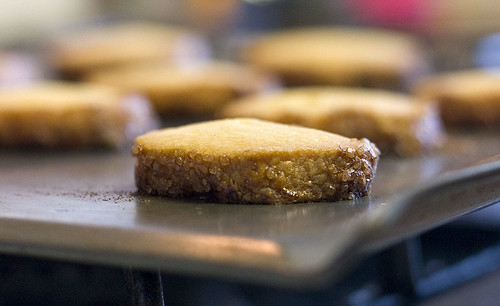
Sablés

Sables

These are the most addictive cookies I’ve ever eaten.  Even more so than Thin Mints.  It took a significant amount of will-power to not eat just one more.

Well, that was until we ate them all.  They only lasted two days.  There was a slight bit of miscommunication in our household involving the cookies (“Matthew ate them all!”). Angela still isn’t amused by that.

Sablés are lightly sweet with a predominant butter flavor.  In many ways, they are very French.  They’re basically the cookie form of a sweet tart dough but they also manage to be just a bit better than straight tart dough would be.  It may just be the shape (or the added sugar coating).

The problem I always have with recipes that need to be refrigerated is that when I want to make cookies, I want to make the cookies right now.  I don’t want to have to wait several hours to have the sweet ambrosia; I want it now.

It was my good fortune to actually wait and make these cookies.  The wait was definitely worth it.  We were nearly fighting over the cookies; they were that good.

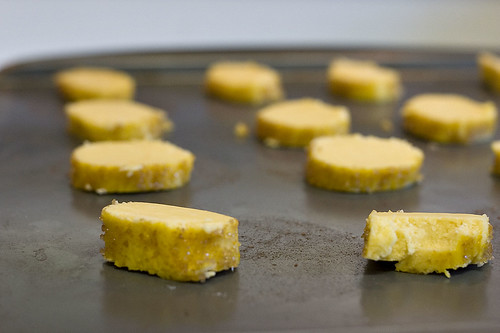
Sables Before Baking

Sablés
Adapted from Baking: From My Home to Yours

2 sticks unsalted butter, softened
1/2 cup sugar
1/4 cup powdered sugar
1/2 tsp salt
3 egg yolks
2 cups all-purpose flour
coarse sugar

  1. In a stand mixer fitted with the paddle attachment, cream the butter at medium speed.
  2. Add the sugars and salt and beat until well blended, about 1 minute.
  3. Reduce the speed to low and beat in 2 of the egg yolks.
  4. Turn off the mixer and add the flour.  Pulse the mixer at low speed 5 times to begin to combine the flour.  Mix at low speed for about 30 seconds or until the flour is well incorporated.
  5. Remove the dough from the mixer bowl and place on a work surface.  Divide the dough in half.  Shape each half into an approximately 9-inch long smooth log and wrap it with plastic wrap.  Refrigerate for at least 3 hours, preferably overnight.
  6. Preheat the oven to 350ºF.
  7. Working with one log at a time, brush it on all sides with beaten egg yolk.  Sprinkle all over with the coarse sugar.
  8. Slice the log into 1/3 inch thick cookies.  Place the cookies on a baking sheet, separated by 1 inch.
  9. Bake for 17 to 20 minutes or until they are lightly browned on top.

Makes about 50 cookies.

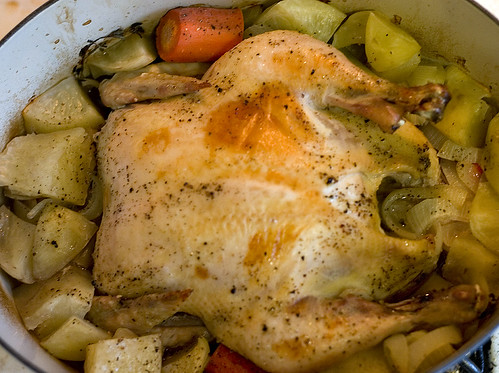
Pot-Roast Chicken and Vegetables

Pot-Roast Chicken and Vegetables

Despite the fact that Angela may claim that I’m always looking for a harder way to do something in the kitchen, I do really appreciate simple and easy food as long as it’s also good.  This manages to be all three.

Simply, this is pot-roasted chicken with vegetables.  There aren’t any complicated ingredients.  There aren’t any complicated instructions.  You put everything in a pot and you cook it.   Like the best simple things, it also manages to taste good.

Vegetables for Pot-Roast Chicken

This would be a near perfect meal to prepare when having guests: simply pile everything into a pot and place it in the oven.  Remove it when the guests arrive and serve.

But what really appeals to me about this recipe is that it almost literally calls for elaboration.  Substituting different vegetables would almost be a no-brainer.  Tarragon could replace the thyme.  The chicken could first be browned in the pot and the vermouth be used to deglaze.  The sauce could be reduced at the end or enriched with butter.

If you look closely, you’ll notice that the ingredient amounts listed below do not match the pictures.  It’s simply that there are only two of us and it’s easier for me to find a way to use the leftover chicken (it ended up in ravioli with spinach and parmesan cheese) then it is for me to find a way to use the leftover chicken as well as leftover vegetables (we still ended up with leftover vegetables; according to the cookbook, pureeing leftover vegetables with leftover sauce makes a good soup).

While simple, this was really quite good.  What really struck me was the fact that very little work led to quite a good dinner.

Pot-Roast Chicken Ready to Cook

Pot-Roast Chicken and Vegetables
Adapted from The River Cottage Cookbook

1 four to six lbs. chicken
2 onions
3 carrots
3 leeks
3 potatoes
2 bay leaves
2 to 3 sprigs of thyme
1 tbsp butter, softened
1 cup dry vermouth
1 cup water
salt and pepper

  1. Preheat the oven to 375ºF.
  2. Peeled the onions, carrots, and potatoes.  Cut the carrots and potatoes into large chunks.  Slice the onions.  Cut the white portion of the leeks into large chunks and discard the rest.
  3. Place the chicken in a large dutch oven.  Surround the chicken with the vegetables and herbs.  Rub the butter onto the exposed portion of the chicken.  Season the chicken and vegetables with the salt and pepper liberally.  Pour the vermouth and water into the dutch oven.
  4. Cook the chicken, covered, in the oven for 50 minutes.
  5. Uncover and cook for 25 to 35 minutes more.
  6. Remove from the oven.  Carve the chicken into large pieces.
  7. Serve the chicken and vegetables with the sauce.

Serves 4 to 5.